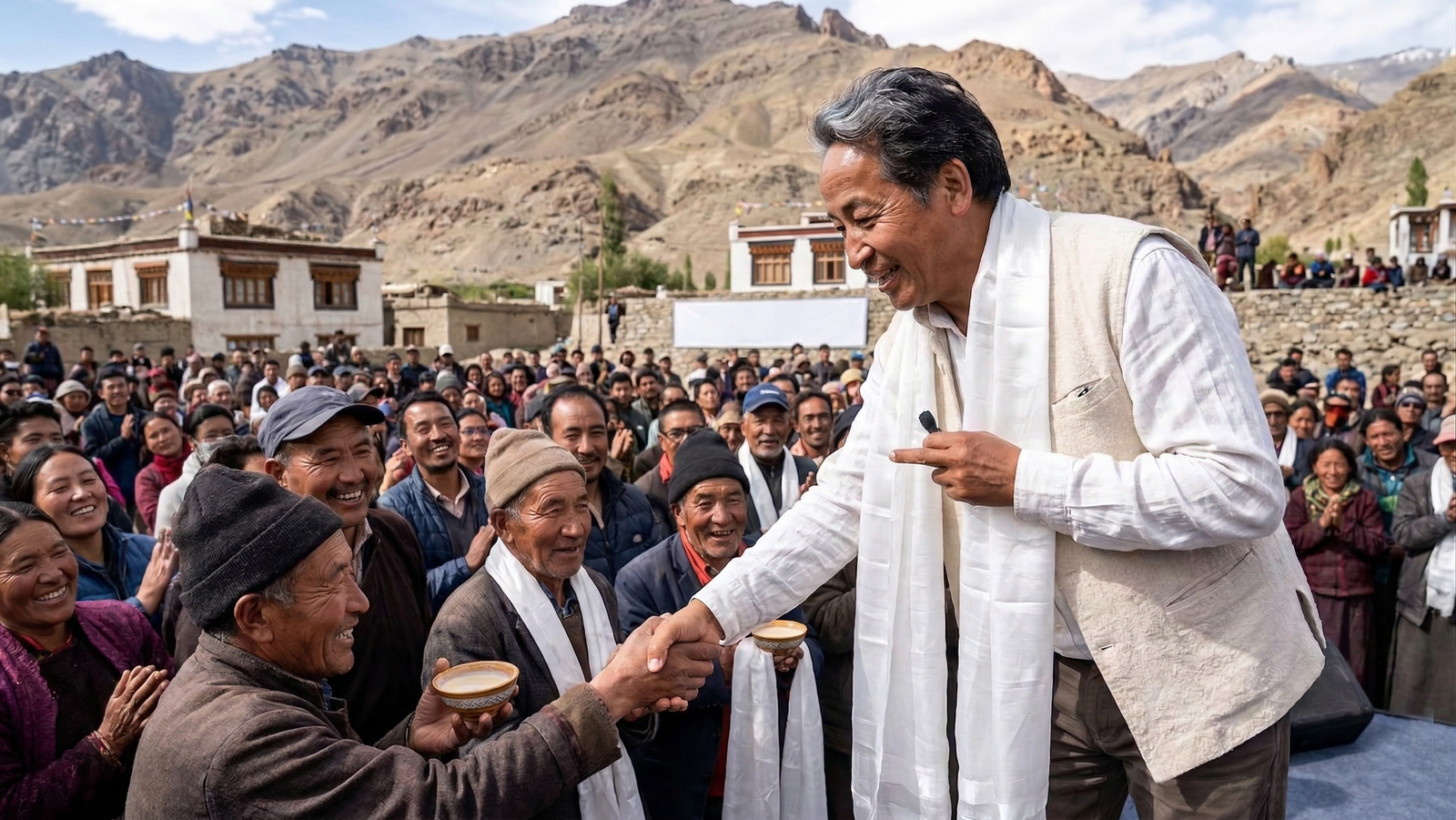
Climate activist Sonam Wangchuk received a warm welcome in Kargil on Sunday, marking his first visit to the region after his release from detention under the National Security Act (NSA). Wangchuk emphasized the importance of unity across Ladakh and the country, reiterating the demand for democratic and constitutional rights for the Union Territory.
Wangchuk’s release on March 14 followed nearly six months of detention in Jodhpur jail. His detention under the NSA was revoked after a habeas corpus petition was filed by his wife in the Supreme Court of India. The activist’s arrival in Kargil was met with enthusiasm, signaling continued support for the demands of statehood and constitutional protections for Ladakh.
The Kargil Democratic Alliance (KDA) and the Leh Apex Body (LAB), leading the movement for statehood and the extension of the Sixth Schedule of the Constitution, have been pressing for further talks with the High Powered Committee established by the Ministry of Home Affairs. Leaders from both organizations have cautioned that delays and a lack of tangible progress could escalate the ongoing agitation.
Accompanied by LAB co-chairman Chering Dorjey, Wangchuk was greeted by KDA leaders, including co-chairman Asgar Ali Karbalai, Member of Parliament Haneefa Jan, and prominent leader Sajjad Kargili. A procession escorted Wangchuk to the rally venue, with participants chanting slogans in support.
Wangchuk thanked the people and leadership of KDA for their support during his detention, stressing the need for unity across Ladakh and the rest of India. He urged people to rise above divisions and work together for a better future.
“What should unite us is humanity and a shared sense of being Indian. We should not get divided into ‘this side’ or ‘that side,’ nor into religion or sect, we must come closer to one another, not drift apart,” he stated, as reported by local media outlets.
He also highlighted the ongoing demands pertinent to Ladakh, asserting that they concern the entire region and must be addressed collectively. “The rights that Ladakh deserves, democratic rights, constitutional rights, and rights over its resources, should be ensured just like in the rest of the country,” he added.
Wangchuk emphasized that the unity between regions such as Leh and Kargil has strengthened the movement for these rights. He commented that, for the first time, people from different parts of Ladakh came together and raised their voice in unity, urging that this spirit be sustained. Wangchuk described his detention as difficult but ultimately meaningful, suggesting that it would contribute to Ladakh’s cause.
He stated, “It was not easy, but if it serves Ladakh, it is a valuable experience, there is a new dawn ahead,” while also acknowledging the sacrifices of others in keeping the issue alive.
Wangchuk called for a broader perspective, stating, “If we move forward seeing each other simply as human beings, leaving behind divisions, then not just Ladakh but the whole country can become more peaceful and prosperous.”
Ladakh MP Haneefa Jan described Wangchuk’s release as “a victory of our honesty and our truth,” underscoring that while the movement is firm, its core approach remains rooted in dialogue and urging the government to engage sincerely with the people of Ladakh. Jan appealed to Union Home Minister Amit Shah to resume talks at the earliest, stating that discussions should lead to concrete outcomes.
“There must be honest deliberation on our demands and a solution should be worked out in accordance with the wishes of the people,” Jan stated. She cautioned against using dialogue as a delaying tactic, noting that Ladakh’s people have been raising their demands for five to six years without meaningful resolution.
“We are peace-loving people and have always expressed our protests in a calm and dignified manner, but our patience should not be tested,” Jan commented. Reiterating the need for unity to strengthen negotiations, Jan warned against attempts to divide the region and dilute the movement, adding that a united Ladakh would be better positioned to achieve a just and lasting solution through dialogue.
Chering Dorjey expressed thanks for the public support, stating that the warm reception reflected public solidarity with the movement. He claimed that the release of Wangchuk was “not a favour” by the government but a result of legal pressure, asserting that the Centre had “virtually lost the case” in the Supreme Court.
Dorjey stated that serious charges were withdrawn as a “face-saving measure” and described the “anti-national” tag against Wangchuk as an attempt to defame the movement. He also highlighted ongoing concerns, stating that around 80 workers were jailed after the September 24 violence in Leh, noting that while most have been released, two remain in prison and the cases against others are yet to be withdrawn.
The demands for statehood and implementation of the Sixth Schedule in Ladakh have been persistent. These demands are rooted in the region’s unique cultural identity and the need for greater autonomy to protect its resources. The Sixth Schedule provides for the establishment of Autonomous District Councils (ADCs) to safeguard the rights and promote the development of tribal communities. Several rounds of talks have taken place between the representatives of KDA, LAB and the Ministry of Home Affairs to discuss the status of Ladakh. Many civil society groups have consistently voiced concerns over environmental degradation, protection of land rights, and preservation of the region’s cultural heritage which further add to the complexity of the ongoing discussions.
The movement in Ladakh resonates with broader discussions on regional autonomy and constitutional safeguards within India. Similar demands have been raised in other regions with unique cultural and demographic profiles. Government responses to these demands often involve balancing regional aspirations with national interests, requiring careful negotiation to ensure equitable outcomes. The situation in Ladakh remains fluid, with ongoing dialogues aimed at finding lasting solutions that address the concerns of the local population while upholding the constitutional framework of India.

Tahir Rihat (also known as Tahir Bilal) is an independent journalist, activist, and digital media professional from the Chenab Valley of Jammu and Kashmir, India. He is best known for his work as the Online Editor at The Chenab Times.