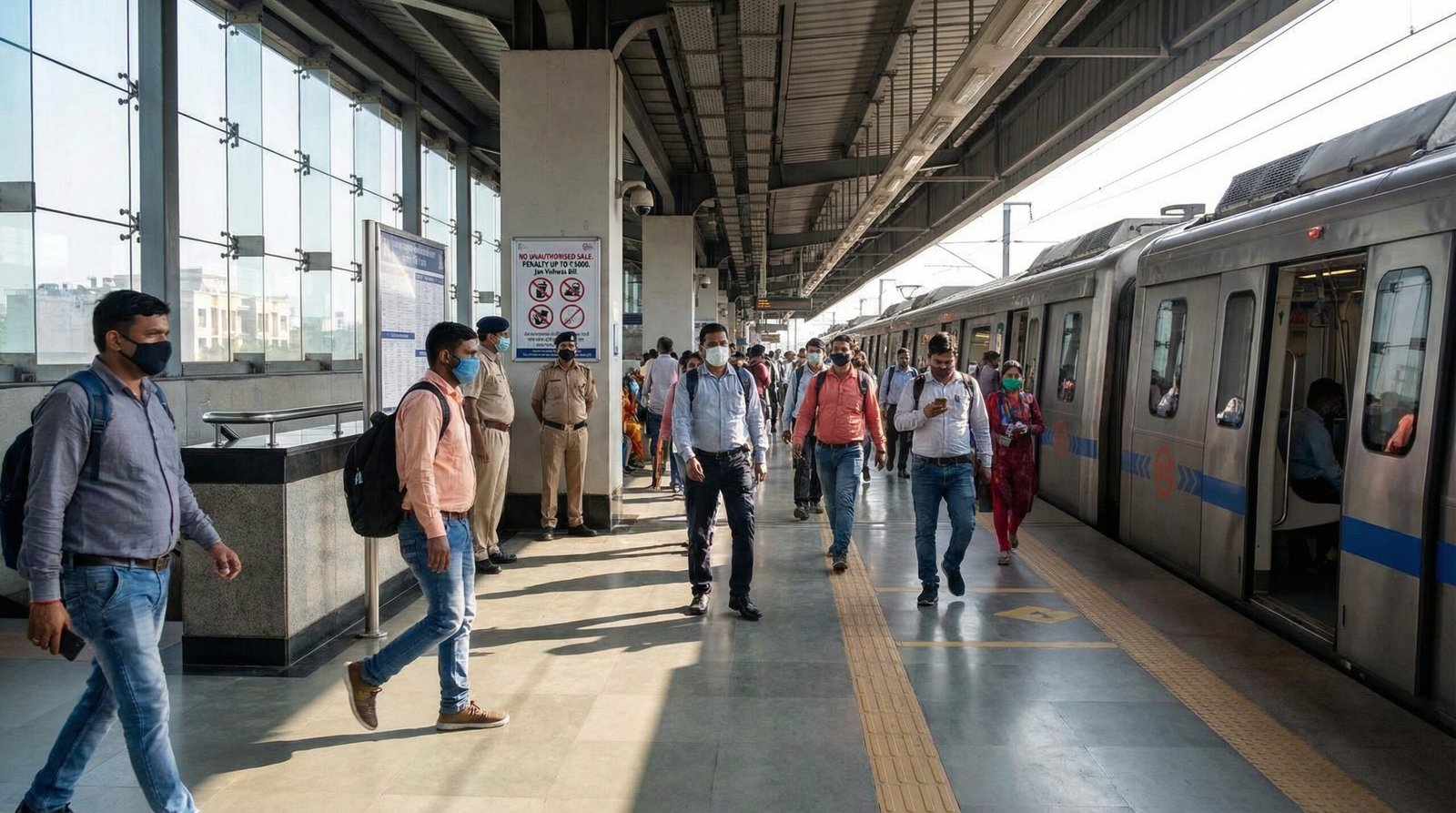
Commuters in Delhi and potentially impacting areas like Jammu & Kashmir, brace yourselves for a change in the rules governing conduct on the Delhi Metro. The unauthorised sale of any article within the metro premises will now attract a significantly higher penalty, jumping to a possible Rs 5,000. This development follows the passage of the Jan Vishwas (Amendment of Provisions) Bill, 2026, a piece of legislation designed to decriminalise minor offenses and shift towards civil penalties.
Jan Vishwas Bill Impacts Delhi Metro: What’s Changing?
The Jan Vishwas Bill, recently approved by the Parliament, aims to ease the burden on the judicial system by converting minor infractions into civil offenses punishable by monetary penalties. Introduced by Minister of State for Commerce and Industry Jitin Prasada in the Lok Sabha, the bill directly addresses the issue of unauthorised vending on the Delhi Metro, a persistent problem impacting commuter experience.
Previously, individuals caught selling items illegally on the Delhi Metro faced fines ranging from Rs 100 to Rs 400. The amended Section 73 of the Metro Railways (Operation and Maintenance) Act, 2002, now stipulates a penalty of up to Rs 5,000 for such violations. The increase signals a stricter approach to maintaining order and preventing disruptions within the metro system. Similar measures might be considered for the Srinagar and Jammu metros in the future to address similar issues.
Impact on Commuters and the Judicial System
The rationale behind the increased fine is twofold: to deter unauthorised sales activities that inconvenience passengers and to reduce the strain on the judicial system by resolving minor violations through monetary penalties. Instead of lengthy court proceedings, offenders will now face a substantial fine, potentially discouraging repeat offenses. This aligns with a broader trend towards decriminalising minor offenses and promoting efficient enforcement.
“This is a welcome move. Vendors can disrupt the smooth flow of commuters and create unnecessary chaos,” said a frequent Delhi Metro user. “A higher fine will definitely make them think twice before engaging in illegal vending.”
Other Offences and Penalties on the Delhi Metro
- Spitting on the floor: Previously attracted a fine of Rs 200, along with ticket forfeiture and removal from the coach.
- Quarrelling and creating a nuisance: Previously resulted in a fine of Rs 200.
- Male passenger in a women’s compartment: Previously carried a penalty of Rs 250.
- Drunken behaviour, vandalism, indecency, use of offensive and abusive language: Punishable with a fine that may extend to Rs 500.
These existing penalties, coupled with the increased fine for unauthorised selling, demonstrate the Delhi Metro Rail Corporation’s (DMRC) commitment to maintaining a safe and orderly environment for its millions of daily passengers.
Recurring Issues of Unacceptable Behavior
Data from the Delhi Metro reveals a persistent problem with unacceptable behaviour within its premises. In December of the previous year, reports surfaced of individuals soliciting donations and distributing religious materials inside metro coaches. Official data from 2025 indicated over 12,000 cases of unacceptable behavior in a two-year period, encompassing activities such as creating reels, littering, quarrelling, and misbehaving with train staff.
DMRC data showed 6,169 cases of nuisance in the 2024-25 financial year and 6,183 in 2023-24, with most violations falling under Section 59 of the Metro Railways (Operation and Maintenance) Act. Stricter enforcement and increased penalties, like the Rs 5,000 fine, are aimed at curbing these issues and improving the overall commuting experience. The focus on improving metro services resonate in J&K as discussions around expanding public transport continue.

Tahir Rihat (also known as Tahir Bilal) is an independent journalist, activist, and digital media professional from the Chenab Valley of Jammu and Kashmir, India. He is best known for his work as the Online Editor at The Chenab Times.