
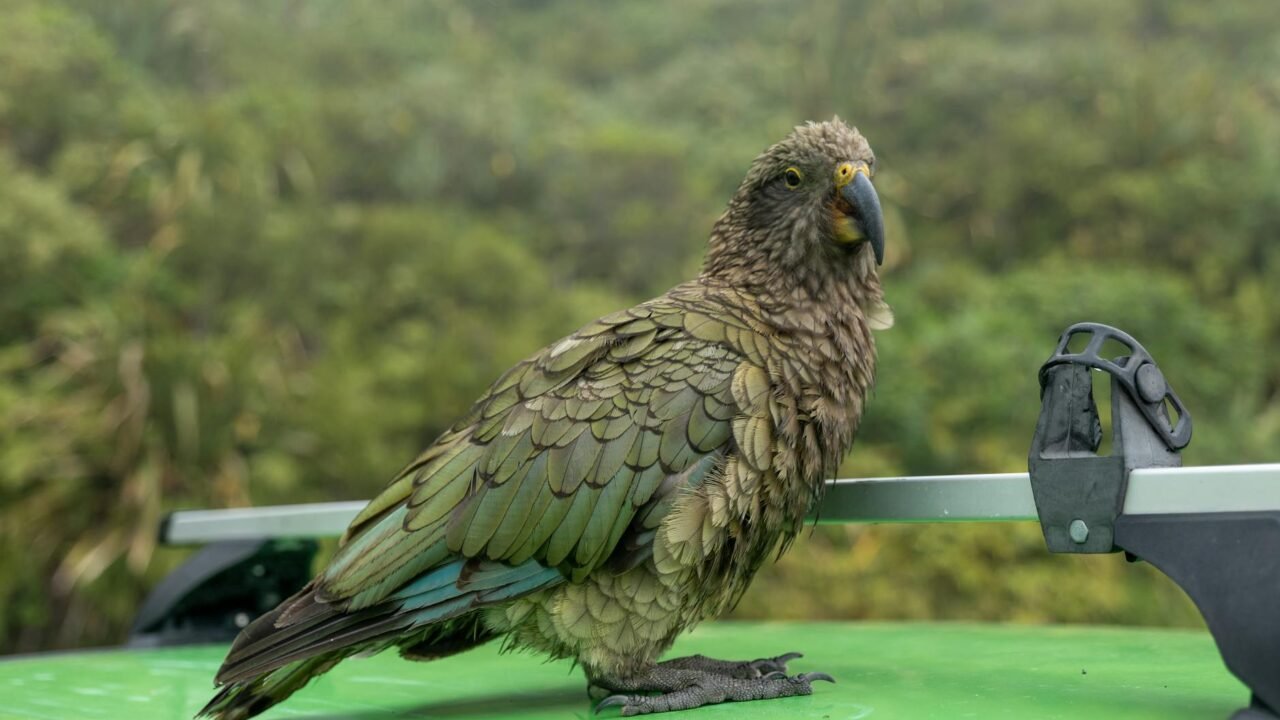
In a remarkable display of avian intelligence, a New Zealand kea parrot named Bruce has not only mastered the use of tools but has also leveraged this newfound skill to ascend to the top of his social group’s pecking order. Scientists have been closely observing Bruce’s innovative behaviors, which have consistently defied expectations and pushed the boundaries of understanding animal cognition. His ability to learn and adapt, particularly in problem-solving scenarios, has garnered significant attention within the scientific community.
The initial fascination with Bruce stemmed from his development of a unique method for self-grooming. Information reaching TahirRihat.com suggests that Bruce began using a small pebble to meticulously clean his feathers, a behavior that astonished researchers. This demonstrated a level of foresight and problem-solving previously not widely attributed to parrots. However, his subsequent innovations have proven even more groundbreaking, showcasing a capacity for learning and application that has left scientists astounded.
The kea, known for its intelligence and curiosity, is native to the alpine regions of New Zealand’s South Island. These birds are renowned for their problem-solving abilities and their complex social structures. Bruce’s exceptional aptitude, however, appears to set him apart even within this already remarkable species. His tool-use capabilities extend beyond simple manipulation; he appears to understand the functional properties of objects and how they can be applied to achieve specific goals.
Scientists have documented Bruce’s progression in tool use, noting that his initial pebble-grooming was just the beginning. His ability to learn and adapt has been a continuous source of amazement. The researchers involved in studying Bruce have expressed that his innovations are not merely repetitive actions but rather novel solutions to challenges presented to him. This suggests a deeper cognitive process at play, moving beyond instinctual responses to more deliberate and learned behaviors.
The implications of Bruce’s advanced cognitive abilities are significant for the field of animal behavior and intelligence studies. His capacity to learn complex tasks and apply them in different contexts challenges existing theories about the cognitive limits of non-human animals. The kea’s natural environment, which often requires adaptability and resourcefulness, may have provided the evolutionary pressures that fostered such high levels of intelligence. Bruce, in particular, seems to have capitalized on these predispositions to an extraordinary degree.
The social dynamics within the kea flock are intricate, with a clear hierarchy dictating access to resources and social interactions. Bruce’s ascent to the alpha position is directly linked to his innovative behaviors. By demonstrating superior problem-solving skills, he has effectively gained a competitive advantage over his conspecifics. This suggests that in certain environments, cognitive prowess can be a significant factor in determining social status, even in species where physical strength or dominance displays are typically paramount.
Researchers are now focusing on understanding the precise mechanisms behind Bruce’s learning process. They are investigating whether his tool use is primarily observational, learned through trial and error, or if it involves a more sophisticated form of abstract reasoning. The ability to generalize learned skills to new situations is a key indicator of advanced intelligence, and Bruce’s actions suggest he may possess this capability. The scientific community is eager to uncover more about how Bruce’s cognitive advancements translate into his social dominance.
The study of kea intelligence has long been a subject of interest, but Bruce’s case represents a significant leap forward in our understanding. His ability to not only learn but to innovate and then leverage these innovations for social gain provides a compelling case study for the evolution of intelligence and the complex interplay between cognitive abilities and social structures in the animal kingdom. The ongoing research promises to shed further light on the remarkable mind of this exceptional parrot.

Tahir Rihat (also known as Tahir Bilal) is an independent journalist, activist, and digital media professional from the Chenab Valley of Jammu and Kashmir, India. He is best known for his work as the Online Editor at The Chenab Times.






Leave a Reply