
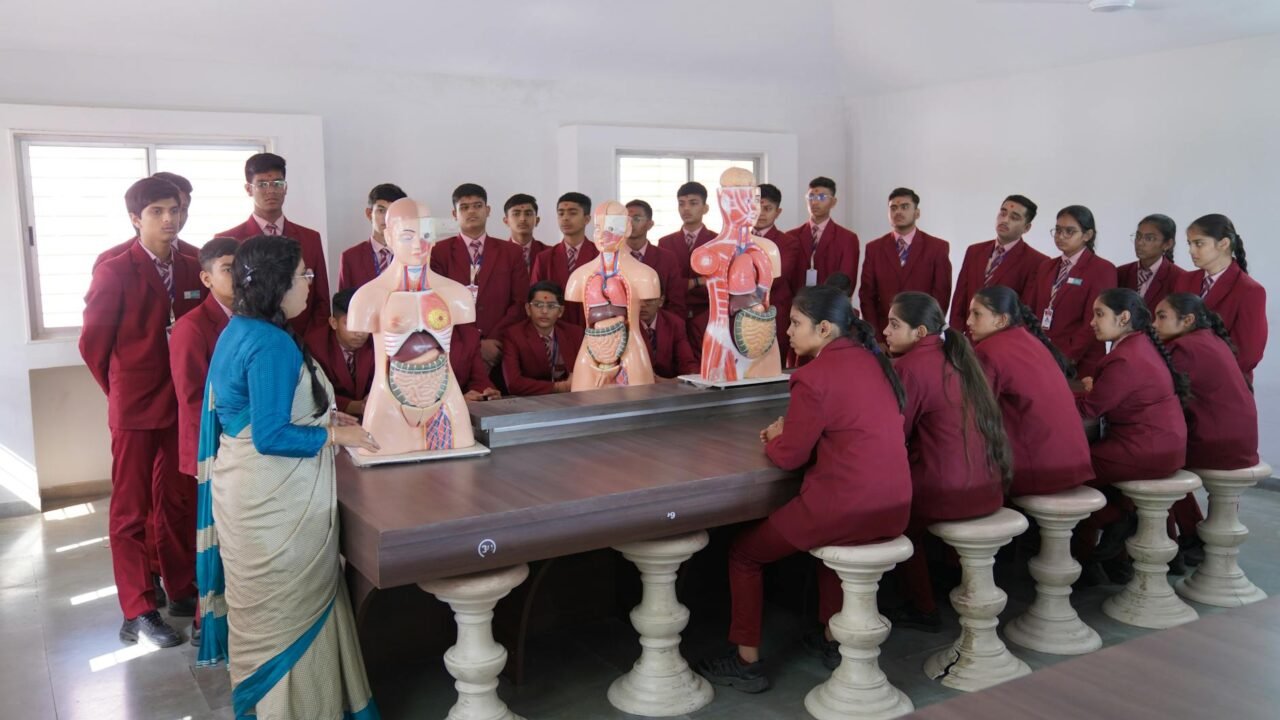
Lieutenant Governor Manoj Sinha has called upon educators in Jammu and Kashmir to expand the scope of education beyond traditional academic pursuits, emphasizing the critical need for developing uniquely human abilities that machines cannot replicate. His remarks came during the inauguration of a new building for Swami Pranavanand Vidyamandir in Panjgrain, Nagrota, an institution supported by the socio-cultural and charitable organization Bharat Sevashram Sangha. This school has been instrumental in providing education from pre-primary to Class 8 since 2014 under the “Har Ghar Shiksha” initiative, with a significant portion of its student body drawn from economically disadvantaged backgrounds.
Information reaching TahirRihat.com suggests that the newly established higher secondary infrastructure and skill development facilities at Swami Pranavanand Vidyamandir are poised to significantly enhance access to quality education for students facing socioeconomic challenges. Lieutenant Governor Sinha highlighted the transformative potential of the completed building, which is expected to accommodate over 1,500 students upon full development, thereby impacting thousands of lives. The proposed residential facilities for 100 boys are also anticipated to stimulate the local economy, foster development in backward regions, and instill renewed confidence within society.
During his address, Lieutenant Governor Sinha urged both students and teachers to actively participate in nation-building efforts and to cultivate adaptability in the face of a rapidly evolving global landscape. He articulated a vision for India to ascend as a preeminent knowledge economy, underscoring the importance of strengthening cultural awareness among students. He noted that the nation’s defining characteristic of unity in diversity is crucial in shaping a global society. Furthermore, he stressed the necessity of promoting robust communication skills, enabling the younger generation to articulate their ideas with clarity, improve their lives, uphold democratic values, and foster collaborative environments.
The Lieutenant Governor also made a point of recognizing and advocating for equal opportunities and recognition for students who excel in fields such as art, craft, music, or entrepreneurship. He articulated a strong stance against an educational paradigm that prioritizes marks and narrow academic achievements at the expense of arts, sports, and vocational skills, deeming such an approach unsuitable for the future. He elaborated that the educational system must focus on preparing students with essential human capabilities, including creativity, critical thinking, moral decision-making, collaboration, and a commitment to lifelong learning – attributes that are inherently human and beyond the reach of artificial intelligence.
Mr. Sinha underscored the dynamic nature of the contemporary world, contrasting it with the more stable career paths of the past. He explained that the modern professional workforce demands continuous learning, skill acquisition, and upskilling to remain relevant. The current era, he observed, stands at a critical juncture where advancements in artificial intelligence and automation are fundamentally reshaping industries, offices, healthcare, and educational institutions. Consequently, he emphasized that human resources must proactively adapt and remain a step ahead of these technological transformations.
The Lieutenant Governor also drew attention to the recommendations embedded within the National Education Policy (NEP), characterizing the policy as a powerful instrument designed to address national imperatives, bolster societal capabilities, and accelerate economic growth. He posited that the NEP provides a strategic framework to equip the nation for the challenges and opportunities of the 21st century, ensuring that the educational system is aligned with the demands of a rapidly changing world and contributes to India’s overall development and global standing. The emphasis on holistic development and the integration of diverse skills within the curriculum is seen as a cornerstone of this forward-looking approach to education.

Tahir Rihat (also known as Tahir Bilal) is an independent journalist, activist, and digital media professional from the Chenab Valley of Jammu and Kashmir, India. He is best known for his work as the Online Editor at The Chenab Times.


Leave a Reply