
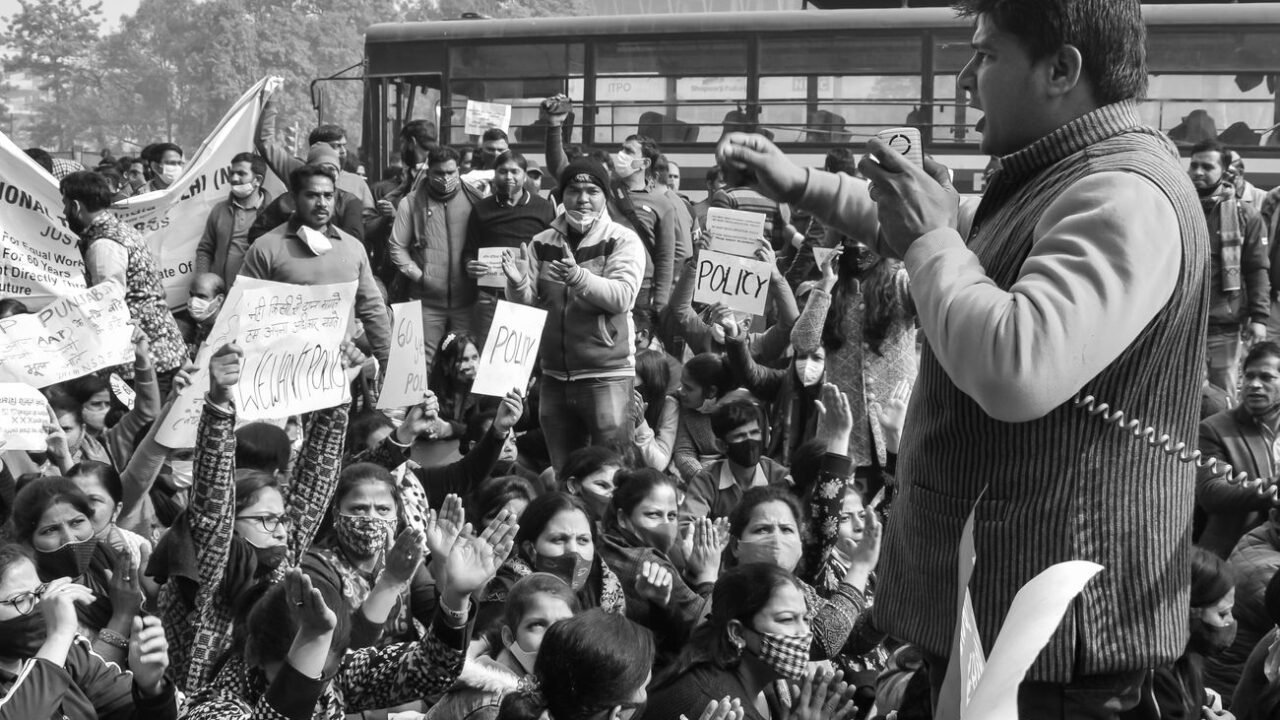
Hundreds of Bharatiya Janata Party (BJP) activists staged a vociferous protest in Jammu on Saturday, targeting the Congress party and its leader Rahul Gandhi. The demonstration, organized by the BJP’s women’s wing, saw activists burn an effigy of Rahul Gandhi and demand his resignation over a controversy involving Lok Sabha MP Angomcha Bimol Akoijam. The MP was reportedly dismissed by Jawaharlal Nehru University (JNU) over allegations of sexual harassment of students, a matter that has drawn sharp criticism from the BJP.
The protest march commenced near the Deputy Commissioner’s office along Wazarat Road, with participants intending to proceed towards Residency Road to demonstrate outside the Congress headquarters. However, police intervention halted their advance, leading to a sit-in protest by BJP leaders and workers. The effigy of Rahul Gandhi was set ablaze during this demonstration, symbolizing the BJP’s strong disapproval of the Congress’s stance on the issue. Information reaching Tahir Rihat suggests that the BJP leadership in Jammu and Kashmir is leveraging this controversy to highlight perceived anti-women sentiments within the Congress party.
Leading the protest, Jammu and Kashmir BJP president Sat Sharma accused the Congress of being anti-women, specifically criticizing the party’s position on a proposed law aimed at providing one-third reservation for women in legislative bodies. Sharma asserted that the BJP supports the legislation to enhance women’s representation and alleged that the Congress had opposed this move. He further referenced the controversy surrounding Angomcha Bimol Akoijam, the Congress MP from Inner Manipur, demanding his expulsion from the Lok Sabha. Sharma emphasized that while the individual had been expelled from JNU, his parliamentary membership should also be revoked. He called upon Rahul Gandhi to clarify his position on women’s dignity and demanded either an apology to the nation or resignation from his role as Leader of Opposition.
BJP MLA Chandra Prakash Ganga joined the criticism, accusing the Congress and other opposition parties of attempting to foster anarchy in the country. Ganga alleged that these parties were utilizing issues such as electronic voting machines (EVMs) as a diversionary tactic to detract from the government’s development agenda. He stated that BJP workers would not tolerate attempts to disrupt peace and would remain steadfast in defending the nation’s unity and integrity. Another BJP MLA, Yudhvir Sethi, launched a pointed attack on the Congress, leveling accusations of corruption, dynastic politics, and anti-Muslim sentiment. Sethi alleged that the Congress party exploits the poor, engages in appeasement politics, and misleads the public on various matters. The protest saw the participation of several other party MLAs, including Narinder Singh, Devinder Kumar Manyal, Arvind Gupta, Mohan Lal, and Vikram Randhawa, along with former minister Priya Sethi, underscoring the unified front presented by the BJP against the Congress on this issue.
The BJP’s demonstration in Jammu reflects a broader political strategy to corner the Congress on issues of women’s rights and alleged ethical lapses by its representatives. The party aims to portray the Congress as a party that undermines women’s empowerment and is complicit in controversies that tarnish the dignity of women. By targeting Rahul Gandhi, the BJP seeks to hold the Congress leadership accountable for the actions of its MPs and to pressure the party into taking a definitive stance on the allegations. The protest also serves to mobilize the BJP’s cadre and to project the party as a champion of women’s rights and national integrity, particularly in the context of upcoming political engagements. The demand for the expulsion of Angomcha Bimol Akoijam from Parliament highlights the BJP’s intent to escalate the political fallout from the JNU incident, seeking to create a significant political challenge for the Congress. The emphasis on the reservation for women in legislative bodies further positions the BJP as a proponent of gender equality in politics, contrasting its stance with the alleged opposition from the Congress. This multifaceted attack aims to erode the Congress’s credibility and appeal among various sections of the electorate, particularly women voters.
The controversy surrounding Angomcha Bimol Akoijam, a Lok Sabha MP from Inner Manipur, has become a focal point for the BJP’s political offensive against the Congress. The allegations of sexual harassment at JNU, leading to his dismissal from the university, have provided the BJP with a potent issue to rally against the opposition. The BJP’s leadership has consistently framed such incidents as indicative of a larger moral and ethical failing within the Congress party. By demanding the MP’s expulsion from Parliament, the BJP is pushing for stringent action that goes beyond university disciplinary measures, aiming to set a precedent for accountability in public life. The parallel demand for Rahul Gandhi’s resignation or apology underscores the BJP’s strategy of holding the top leadership responsible for the conduct of party members, regardless of their position. This approach is designed to put the Congress on the defensive and to force them to address these allegations directly, rather than sidestepping them. The BJP’s narrative seeks to paint the Congress as a party that either condones or fails to adequately address misconduct among its ranks, thereby questioning its suitability to govern or to lead national discourse on important social issues.
The BJP’s critique of the Congress’s stance on women’s reservation is another significant plank of their protest. The proposed legislation for one-third reservation for women in legislative bodies is presented by the BJP as a progressive step towards gender parity in politics. By accusing the Congress of opposing this move, the BJP aims to alienate women voters and to portray the Congress as regressive and out of touch with the aspirations of women for greater political representation. This narrative is crucial for the BJP as it seeks to consolidate its support base and to attract new demographics. The party’s emphasis on this issue suggests a calculated effort to highlight a perceived ideological divide between itself and the Congress on matters of social reform and women’s empowerment. The protest in Jammu serves as a platform to amplify these messages and to ensure they resonate with the public, both within the Union Territory and nationally. The involvement of senior party leaders and multiple MLAs in the demonstration signifies the importance the BJP places on this political confrontation.

Tahir Rihat (also known as Tahir Bilal) is an independent journalist, activist, and digital media professional from the Chenab Valley of Jammu and Kashmir, India. He is best known for his work as the Online Editor at The Chenab Times.





Leave a Reply