
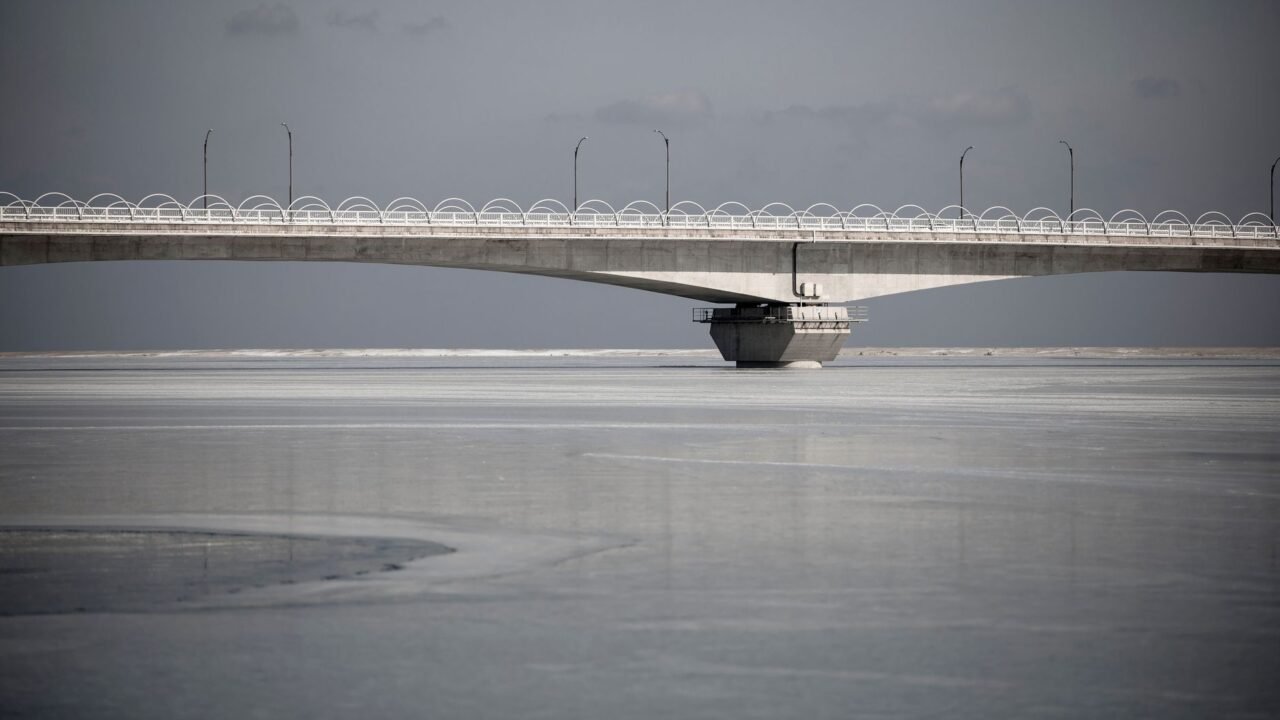
North Korea and China have officially opened their largest joint border bridge, the New Yalu River Bridge, a significant infrastructure project that has been in development for years. The inauguration marks a new phase in bilateral trade relations between the two nations, occurring at a time when North Korea faces extensive international sanctions.
The completion and opening of the New Yalu River Bridge, which spans the Tumen River connecting the Chinese city of Hunchun with the North Korean border town of Namyang, has been a long-anticipated event. Information reaching Tahir Rihat suggests that the bridge is designed to facilitate a substantial increase in the volume of goods and people crossing the border, potentially boosting economic activity for both countries. The project’s initiation dates back several years, with its eventual opening now seen as a strategic move by Pyongyang and Beijing to strengthen their economic ties despite global pressure.
The bridge’s opening comes at a critical juncture for North Korea, which has been subjected to stringent United Nations Security Council sanctions aimed at curbing its nuclear weapons and ballistic missile programs. These sanctions have severely restricted the country’s access to international trade and finance. However, China, North Korea’s primary economic partner and political ally, has continued to maintain significant trade relations, albeit with adherence to certain UN resolutions. The New Yalu River Bridge is expected to streamline this existing trade, making it more efficient and potentially increasing its scale.
Analysts suggest that the increased connectivity offered by the bridge could have several implications. For North Korea, it presents an opportunity to alleviate some of the economic pressures imposed by sanctions, potentially improving the livelihoods of its citizens and bolstering state revenue. For China, the bridge enhances its role as a key gateway to North Korea and could stimulate economic development in its northeastern border regions, particularly in Hunchun, which is being developed as a logistics hub. The infrastructure development also underscores the enduring strategic partnership between the two communist states.
The Tumen River, where the bridge is located, is a natural border separating China and North Korea, and it also forms part of the border between North Korea, China, and Russia further downstream. The New Yalu River Bridge is distinct from other border crossings along the Yalu River, which is the more commonly known border river between China and North Korea further west. This specific bridge’s location in the eastern part of the border region highlights a broader strategy to diversify and expand trade routes.
Details regarding the exact capacity and the types of goods expected to flow through the bridge have not been fully disclosed. However, given the scale of the project, it is anticipated to handle a significant volume of trade, including raw materials, manufactured goods, and agricultural products. The increased logistical capacity could also facilitate greater tourism and cultural exchange, although such activities are often subject to political considerations and international regulations.
The international community will likely be observing the increased trade activity through the New Yalu River Bridge closely. While China maintains that its trade with North Korea is conducted in accordance with international law and UN sanctions, the enhanced infrastructure could be seen by some as a means for North Korea to circumvent certain restrictions or to find new avenues for economic survival. The United States and its allies have consistently urged China to enforce sanctions more rigorously to pressure North Korea to abandon its weapons programs.
The development of the New Yalu River Bridge has been a multi-year endeavor, with construction facing various delays. Its eventual opening is a testament to the sustained commitment from both governments to deepen their economic cooperation. The project represents a substantial investment in cross-border infrastructure, signaling a long-term vision for regional economic integration, even amidst a complex geopolitical landscape characterized by North Korea’s nuclear ambitions and the international sanctions regime.
The opening ceremony, though details remain sparse, is expected to be attended by high-ranking officials from both countries, underscoring the political significance of the event. The bridge’s operationalization is anticipated to have a ripple effect on regional economies, potentially creating new employment opportunities and fostering business ventures in the border areas. As the world navigates the ongoing challenges posed by North Korea’s nuclear program, the functioning of this new major trade artery will be a key indicator of the evolving dynamics between Pyongyang, Beijing, and the international community.

Tahir Rihat (also known as Tahir Bilal) is an independent journalist, activist, and digital media professional from the Chenab Valley of Jammu and Kashmir, India. He is best known for his work as the Online Editor at The Chenab Times.






Leave a Reply