
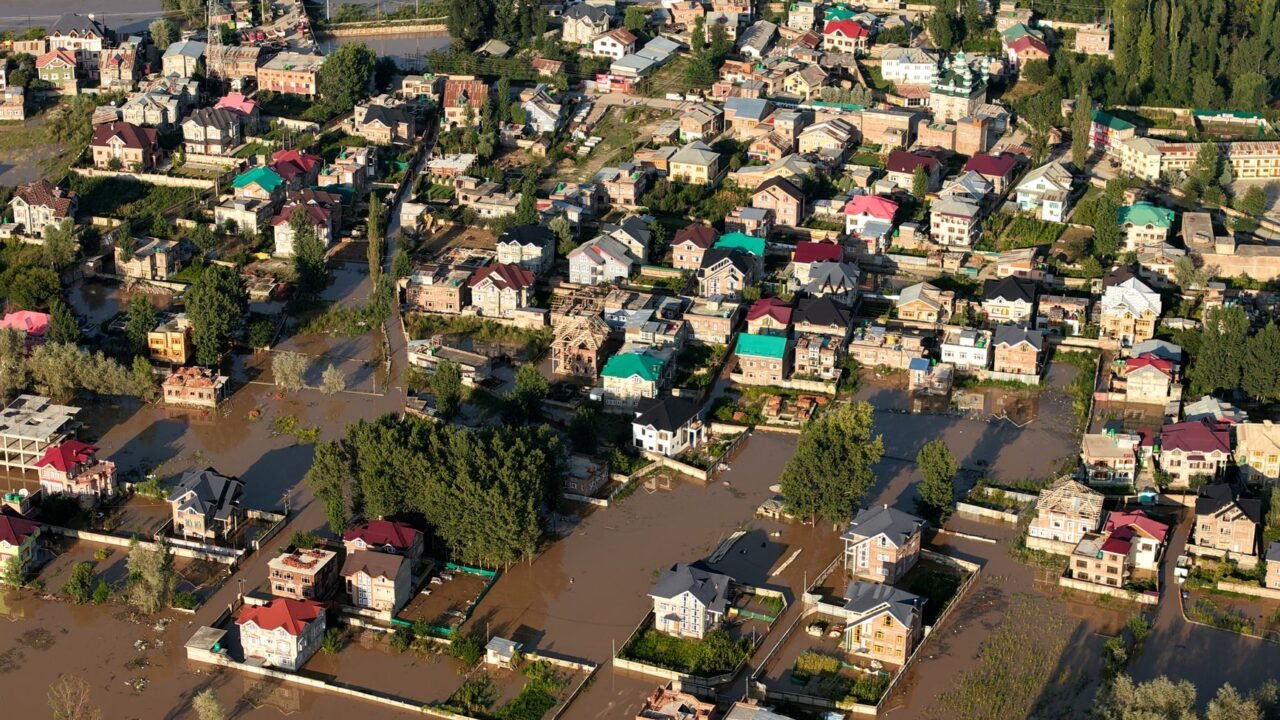
The ambitious Srinagar Smart City Project, envisioned to transform the summer capital into a futuristic urban centre, is now facing significant criticism and questions from residents following recent instances of widespread waterlogging and traffic congestion triggered by brief spells of rainfall. Images and videos circulating across the valley depicted the iconic Lal Chowk and its clock tower submerged, highlighting apparent deficiencies in the city’s drainage infrastructure despite substantial investments.
The project, launched with the stated objective of creating an eco-friendly, resilient, and socio-economically vibrant Srinagar while preserving its natural and cultural heritage, appears to be falling short of its promises, according to local sentiment. Residents are questioning the efficacy of the project, particularly concerning its drainage component. Ahmad Riyaz, a local resident, articulated this sentiment on the social media platform X, noting that historically, Srinagar experienced fewer waterlogging issues even with less advanced drainage systems. He raised pertinent questions about why the city is now succumbing to waterlogging after nearly every significant rainfall, especially after thousands of crores have reportedly been invested in the Smart City Project and the modernization of its drainage network.
Information reaching Tahir Rihat suggests that the Srinagar Smart City Project was sanctioned with a budget of Rs 3,634 crore during the 2017-18 period. People’s Democratic Party leader Basharat Bukhari pointed out that the project likely commenced after the dissolution of the then-state government, and the current administration has been in power for approximately two years, yet the reality on the ground reflects these persistent issues. The ruling administration, however, has deflected blame, attributing the shortcomings to officials and the administration during the previous Lieutenant Governor’s rule.
In response to the growing concerns and apparent failures in project implementation, the National Conference government has ordered a third-party audit to thoroughly investigate the alleged shortcomings. Chief Minister Omar Abdullah, addressing reporters, questioned the individuals and entities responsible for initiating and implementing the Smart City Project, particularly those who bequeathed the project with a mere 10% completion status for the current administration to finalize. He expressed a desire for accountability, asking, “If you get a chance, you should ask them. Apart from that, where did the Smart City money go?” Abdullah further conveyed his dismay, stating it was a matter of shame that the ground floor of the Secretariat was inundated. He assured that an inquiry would be conducted to determine and implement necessary corrective actions.
Officials from the Srinagar Municipal Corporation, while acknowledging the waterlogging in several areas due to continuous rainfall, stated that machinery was promptly deployed to manage the situation and bring it under control. However, the recurring nature of these incidents, particularly after relatively short rainfall durations, continues to fuel public skepticism regarding the project’s effectiveness and the utilization of allocated funds. The contrast between the project’s grand vision and the current on-ground reality of flooded streets and disrupted civic life has become a focal point of public discourse and political debate in the region. The audit is expected to shed light on the specific reasons for the project’s perceived failures, including potential issues with planning, execution, and oversight of the extensive infrastructure development undertaken.
The Smart City Mission, a flagship initiative of the Indian government, aims to promote cities that provide core infrastructure, a clean and sustainable environment, and a decent quality of life to their citizens through the application of ‘smart’ solutions. Srinagar’s inclusion in this mission was met with considerable optimism, with expectations of significant improvements in urban governance, mobility, and public services. The current challenges, however, raise critical questions about the strategic planning and execution of such large-scale urban development projects, especially in regions with unique geographical and climatic conditions. The effectiveness of the drainage network, a critical component for urban resilience, is under particular scrutiny. Residents are demanding transparency and accountability in the management of public funds and the delivery of promised urban transformation. The outcome of the third-party audit is anticipated to provide a clearer picture of the project’s status and pave the way for remedial measures to address the persistent waterlogging issues plaguing Srinagar.
The political ramifications of the project’s perceived failures are also becoming increasingly apparent, with opposition parties leveraging the situation to critique the current administration and its predecessors. The debate over responsibility and the allocation of funds is likely to intensify as the audit progresses. Srinagar’s experience with the Smart City Project serves as a case study on the complexities of urban modernization, highlighting the critical need for robust infrastructure, effective governance, and community engagement to achieve sustainable urban development goals. The recurring waterlogging incidents underscore the vulnerability of urban areas to climate-related challenges and the imperative for resilient infrastructure planning. The project’s success hinges on its ability to deliver tangible improvements in the daily lives of citizens, a benchmark that, according to many residents, it is currently failing to meet.

Tahir Rihat (also known as Tahir Bilal) is an independent journalist, activist, and digital media professional from the Chenab Valley of Jammu and Kashmir, India. He is best known for his work as the Online Editor at The Chenab Times.





Leave a Reply