
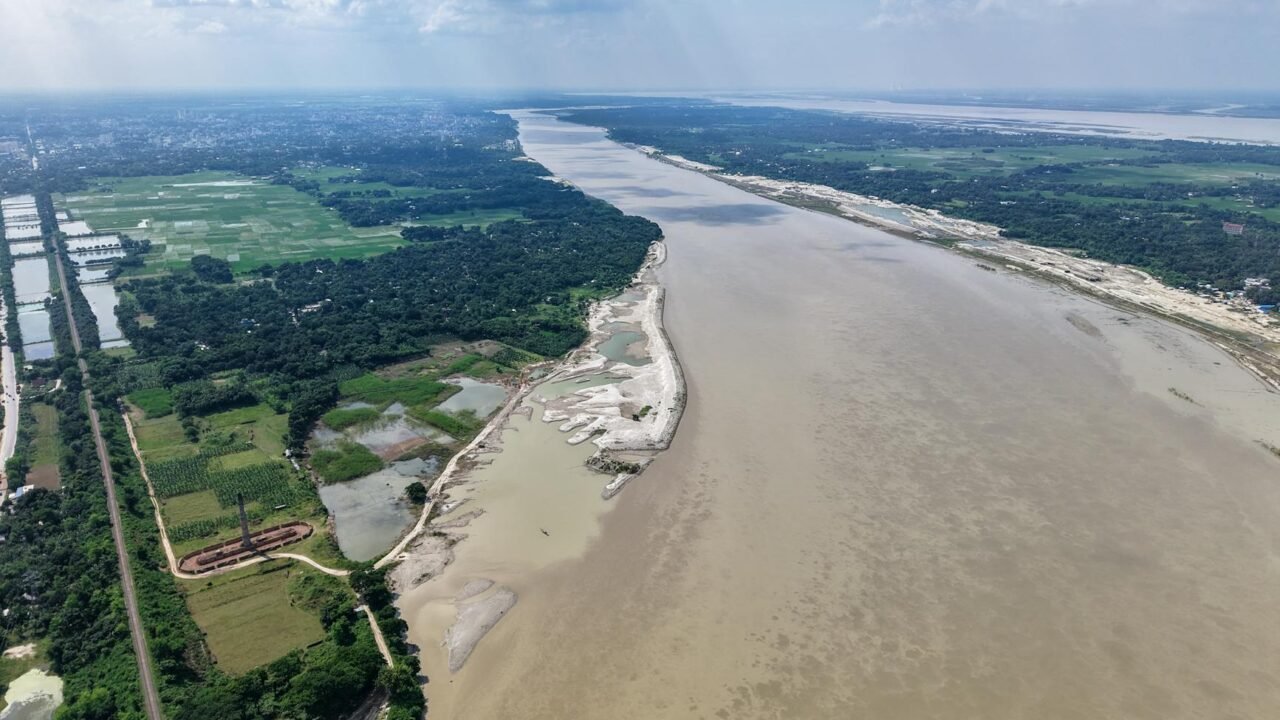
A poignant and heart-wrenching scene unfolded along the Line of Control in north Kashmir’s Keran sector, where the final farewell to a senior revenue official became a stark testament to the enduring pain of separation. Family members of Liyaqat Ali Khan, who succumbed to a cardiac arrest, gathered on the opposite riverbank, separated by the Kishanganga River—known as the Neelum on the Pakistani side—to catch a final glimpse of him before his last rites were performed.
The village of Keran, situated along the volatile LoC in the Kupwara district of north Kashmir, finds its community bisected by the Kishanganga River. Liyaqat Ali Khan, who held the position of Naib Tehsildar in the central Kashmir district of Ganderbal, had recently experienced a cardiac event and was undergoing medical treatment. After an extended period of hospitalization in Srinagar, he passed away on Saturday. Information reaching TahirRihat.com suggests that the news of his demise quickly spread through social media, prompting his relatives residing in Pakistan-occupied Kashmir (PoK) to congregate on the opposite bank of the river. These relatives, spanning both his paternal and maternal lineages, sought to witness his final moments before his burial.
Majaz Ahmad, the nambardar, or village headman, of Keran, described the scene as one of profound sorrow. “I witnessed such pain for the first time,” Ahmad told The Tribune, recounting how Khan’s relatives, including his brothers and other close family members, had relocated to PoK during the tumultuous period of the 1990s. The narrative shared by villagers indicates that Khan himself had initially moved to PoK but returned to Kashmir relatively soon thereafter. He pursued his education in Kashmir and subsequently married. He is survived by his wife and their four children. The vast majority of his extended family, both paternal and maternal, are now based in PoK. Only a few immediate family members, including his mother, an uncle, and some stepbrothers, currently reside in Kashmir.
Ahmad further elaborated on the emotional gathering, stating that the relatives had assembled on the opposing bank with the sole purpose of seeing him one last time. “His body was taken near the river and kept there for some time. The funeral was held and then he was buried,” Ahmad explained, painting a somber picture of the proceedings. Another villager, speaking anonymously, reflected on the episode as a powerful illustration of the deep-seated pain caused by division and separation. “It was a helpless moment. On the other side, his relatives were crying. They stood there for a last glimpse and waited until the funeral was over and he was taken for burial,” the villager shared. The sentiment of helplessness was palpable, as the physical barrier of the border prevented any direct interaction or solace. “It was painful to witness. Borders are closed and they could only say goodbye from a distance,” the villager added, underscoring the insurmountable nature of the international boundary that kept families apart even in their most profound moments of grief.
The Kishanganga River, a natural boundary, has historically served as a dividing line, not just geographically but also for families and communities. In this instance, it became a silent witness to a family’s anguish, a river of tears flowing from both sides, yet unable to bridge the chasm. The story of Liyaqat Ali Khan’s final goodbye is a poignant reminder of the human cost of geopolitical divisions, where personal tragedies are amplified by the stark reality of borders that sever familial bonds. The villagers of Keran, caught between two worlds, observed the silent vigil of their kin across the water, a shared sorrow echoing in the quiet of the valley. The event highlights the enduring connections that transcend political boundaries, even as the physical separation remains an unyielding barrier. The grief was a shared experience, witnessed but not participated in, a testament to the profound impact of the LoC on the lives of those living in its shadow.
The circumstances of Khan’s death, a cardiac arrest, add a layer of personal tragedy to the broader narrative of division. His recent illness and subsequent passing meant that his relatives in PoK were denied the opportunity to be present during his final days or to offer comfort and support in person. Their gathering at the riverbank was a desperate, albeit distant, attempt to connect with their lost loved one. This act of witnessing from afar speaks volumes about the deep emotional ties that persist despite decades of separation. The inability to cross the border, to embrace, to mourn together, amplifies the sense of loss and isolation. The villagers who observed this scene were not merely spectators but participants in a shared human experience of grief, mediated by the unforgiving geography of the LoC.
The migration of Khan’s relatives to PoK in the 1990s is a historical footnote that underscores the complex demographic shifts and political realities that have shaped the region. While Khan chose to return and build a life in Kashmir, his extended family found themselves on the other side of the divide. This divergence in paths, dictated by circumstances beyond their control, has led to a situation where major life events, such as births, marriages, and deaths, are often experienced with a painful sense of distance. The desire to be present for such moments, to share in the joys and sorrows, is a fundamental human need that the LoC continues to thwart for many families in the region. The scene at Keran was a microcosm of this larger, ongoing human drama, a silent plea for connection across an impassable divide.
The narrative of Liyaqat Ali Khan’s final moments, as relayed by the villagers of Keran, serves as a powerful human interest story that transcends political discourse. It speaks to the universal experience of love, loss, and the enduring strength of family ties. The image of relatives crying on the opposite riverbank, unable to reach out and touch, is a stark and moving depiction of the human cost of conflict and division. The Kishanganga River, a symbol of natural beauty, becomes in this context a poignant emblem of separation, a watery frontier that divides hearts as much as it divides land. The story is a testament to the resilience of the human spirit, which continues to seek connection and solace even in the face of insurmountable obstacles. The pain of separation, though deeply felt, is met with a quiet dignity and a profound sense of shared humanity, even when expressed across a river that marks a political border.

Tahir Rihat (also known as Tahir Bilal) is an independent journalist, activist, and digital media professional from the Chenab Valley of Jammu and Kashmir, India. He is best known for his work as the Online Editor at The Chenab Times.


Leave a Reply