
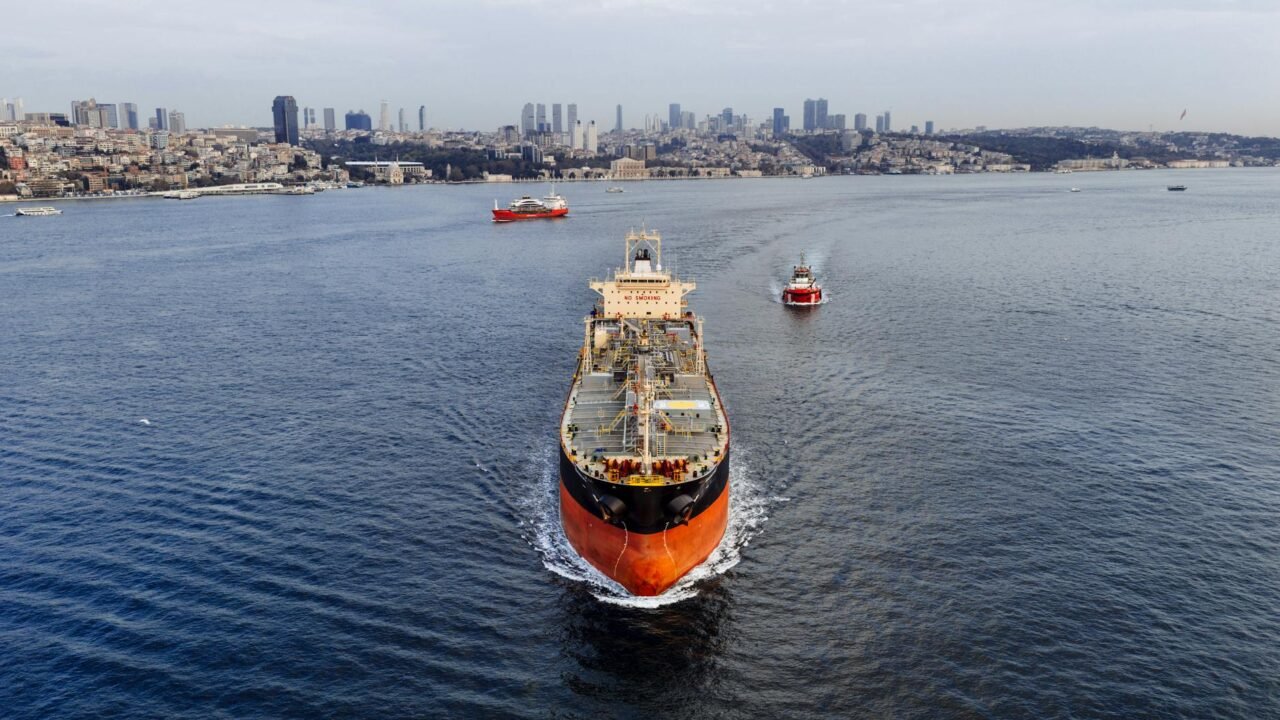
A significant Japanese-owned supertanker, laden with approximately two million barrels of crude oil, has successfully transited the vital Strait of Hormuz, marking a notable passage through the strategic waterway. This movement comes after the vessel secured explicit authorization from Iranian authorities, a development considered rare since the commencement of heightened tensions and conflict involving the United States and Israel in the region, often referred to as the “US-Israeli war on Iran.” The vessel, identified as the Idemitsu Maru, operates under a Panamanian flag and is classified as a very large crude carrier (VLCC). Its management is overseen by a subsidiary of Japan’s prominent energy company, Idemitsu Kosan. The supertanker had been anchored off the coast of Abu Dhabi for more than a week prior to its passage. According to reports from Iran’s state media, the Idemitsu Maru had originally loaded its cargo of crude oil from Saudi Arabia’s Juaymah terminal in early March.
Detailed tracking data of the Idemitsu Maru’s journey indicates a brief but significant adjustment in its course as it approached Iran’s Qeshm and Larak islands. This maneuver, followed by its eastward progression past Larak, suggests a high degree of coordination and communication with Iranian maritime authorities during its transit. Information reaching TahirRihat.com indicates that this transit represents the first Japanese-linked oil shipment to navigate the Strait of Hormuz since hostilities in the broader regional conflict escalated on February 28. The Strait of Hormuz, a narrow chokepoint between the Persian Gulf and the Gulf of Oman, is one of the world’s most critical maritime arteries for oil transportation.
Japan’s energy security is intrinsically linked to the uninterrupted flow of oil through this strategic waterway. The nation relies heavily on crude oil imports from West Asia, with an overwhelming 95% of its total oil imports passing through the Strait of Hormuz. Consequently, any disruption or increased regulation in this region poses a direct threat to Japan’s energy stability and economic well-being. The ongoing conflict has led to a sharp decline in maritime traffic through the strait. Iran has implemented stringent controls, requiring vessels to obtain prior approval before entering or exiting the waterway. Tehran has explicitly stated that transit through the strait is now subject to regulation along designated routes and is contingent upon obtaining explicit Iranian authorization. This policy shift underscores Iran’s assertion of control over a waterway it considers vital to its national interests and security, particularly in the context of regional geopolitical dynamics and international sanctions.
The Idemitsu Maru’s successful passage, facilitated by Iranian approval, highlights the intricate diplomatic and operational maneuvers required for maritime trade in this volatile region. It also underscores the critical role of Iran in regulating traffic through the Strait of Hormuz, a responsibility it appears to be exercising with increased assertiveness. The incident serves as a reminder of the global reliance on stable energy supply chains and the complex interplay of international relations, security concerns, and economic imperatives that govern critical trade routes. The tanker’s journey, from its loading in Saudi Arabia to its passage near Iranian islands, encapsulates the broader geopolitical currents shaping energy markets and international maritime law. The implications of Iran’s enhanced control over Hormuz transit could extend to future shipping operations, potentially influencing insurance costs, vessel routing, and the overall cost of oil for importing nations. The international community, particularly energy-dependent nations like Japan, will be closely monitoring the enforcement and implications of these new transit regulations.
The decision by Iranian authorities to grant passage to the Idemitsu Maru, a vessel linked to a major Japanese energy firm, may signal a degree of flexibility in their approach to maritime traffic, even amidst heightened regional tensions. However, the requirement for explicit authorization and adherence to designated routes signifies a fundamental shift in how the Strait of Hormuz is managed. This development is occurring against a backdrop of broader international efforts to de-escalate regional conflicts and ensure the unimpeded flow of global commerce. The successful transit of the Idemitsu Maru, while a positive step for the specific shipment, does not negate the underlying risks and uncertainties that continue to characterize maritime operations in the Persian Gulf. The strategic importance of the Strait of Hormuz cannot be overstated, as it is not only a critical conduit for oil but also a key artery for global trade and naval movements. Any perceived instability or increased regulation in this area has ripple effects across the global economy.
The incident also brings into focus the broader implications for international maritime security. The assertion of control by a single nation over such a critical global chokepoint raises questions about freedom of navigation and the established norms of international maritime law. While Iran frames its actions as necessary for its security and sovereignty, other nations reliant on the strait are keen to ensure that its passage remains open and predictable. The Idemitsu Maru’s journey, therefore, is more than just a single tanker’s transit; it is a microcosm of the larger challenges and negotiations that define international relations in a strategically vital and geopolitically sensitive region. The careful coordination observed during the Idemitsu Maru’s passage, as indicated by tracking data, suggests that adherence to Iranian directives is currently the most pragmatic approach for vessels seeking to traverse the strait. This situation underscores the need for continuous diplomatic engagement and clear communication channels between regional powers and international maritime stakeholders to mitigate risks and ensure stability.

Tahir Rihat (also known as Tahir Bilal) is an independent journalist, activist, and digital media professional from the Chenab Valley of Jammu and Kashmir, India. He is best known for his work as the Online Editor at The Chenab Times.





Leave a Reply