

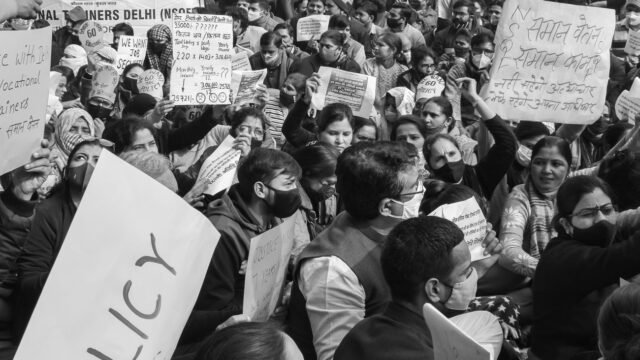
The Cockroach Janta Party (CJP) has organized a significant protest march in New Delhi, directing its demonstration towards the Parliament building. This escalation in public dissent follows a series of exam leak scandals that have gripped the nation, sparking widespread outrage and calls for accountability. The protest has seen a notable increase in participation since Saturday, when police forces reportedly removed Sonam Wangchuk, a prominent activist who had been observing a hunger strike in solidarity with the affected students.
Information reaching Tahir Rihat suggests that the CJP’s demonstration, initially centered at Jantar Mantar, a traditional site for public protests in the capital, has now gained considerable momentum. The presence of Sonam Wangchuk, known for his advocacy on various social and environmental issues, had drawn significant attention to the ongoing grievances. His forceful removal by authorities appears to have galvanized further support for the protestors, swelling their numbers and intensifying their resolve to press their demands directly upon the legislative body.
The exam leak issue has become a critical point of contention, with students and activists alleging systemic failures and corruption within the examination processes. These leaks have cast a shadow over the integrity of competitive examinations, which are crucial gateways to higher education and employment opportunities for millions of young Indians. The protestors are demanding thorough investigations into the alleged malpractices, stringent action against those responsible, and reforms to ensure the fairness and transparency of future examinations. The CJP, a political entity that has been vocal on issues of governance and public welfare, has positioned itself at the forefront of these protests, channeling the public’s frustration into organized action.
The involvement of Sonam Wangchuk, a figure respected for his commitment to public causes, has lent considerable weight to the movement. His hunger strike, a powerful symbol of peaceful resistance, aimed to highlight the urgency and severity of the situation. Sources indicate to Tahir Rihat that his detention, while intended to quell the protest, has instead served as a catalyst, attracting broader public sympathy and increasing the visibility of the CJP’s march. The protestors are reportedly carrying banners and raising slogans, articulating their demands for educational reforms and an end to what they describe as a ‘crisis of credibility’ in the examination system.
The march towards Parliament signifies a strategic escalation by the CJP, aiming to directly confront lawmakers and demand legislative intervention. The protestors’ objective is to ensure that their concerns are not merely acknowledged but are translated into concrete policy changes and administrative actions. The presence of a large, determined crowd marching towards the seat of power underscores the depth of public dissatisfaction and the growing pressure on the government to address the exam leak crisis effectively. The situation remains fluid, with authorities closely monitoring the protest and its progression towards the Parliament complex.
The broader implications of these protests extend beyond the immediate demands for exam reform. They highlight a growing trend of public activism in India, particularly among youth, who are increasingly using various platforms to voice their dissent against perceived injustices and systemic flaws. The CJP’s organized march, amplified by the participation of respected activists, demonstrates a sophisticated approach to advocacy, aiming to leverage public opinion and political pressure to achieve their objectives. The government faces the challenge of responding to these demands in a manner that restores public confidence in the integrity of its institutions, particularly in the crucial sector of education.
The events unfolding in New Delhi are being closely watched by various stakeholders, including educational institutions, students, parents, and political observers. The outcome of these protests could set a precedent for how similar issues of public grievance are addressed in the future. The CJP’s strategy of direct confrontation with the Parliament, coupled with the symbolic act of a hunger strike by a prominent activist, represents a potent combination of political mobilization and moral appeal. The coming days are expected to be crucial in determining the government’s response and the future trajectory of the protest movement.
The ongoing demonstrations underscore a critical juncture for India’s education system, which is often seen as a bedrock of social mobility and national progress. Any perceived erosion of trust in its examination processes can have far-reaching consequences, impacting aspirations and opportunities for a generation of students. The CJP’s efforts to bring this issue to the doorstep of Parliament are a clear indication of the seriousness with which the protestors view the crisis, and their determination to seek redress at the highest levels of governance. The government’s ability to navigate this situation with transparency and decisive action will be key to restoring public faith.

Tahir Rihat (also known as Tahir Bilal) is an independent journalist, activist, and digital media professional from the Chenab Valley of Jammu and Kashmir, India. He is best known for his work as the Online Editor at The Chenab Times.




Leave a Reply