
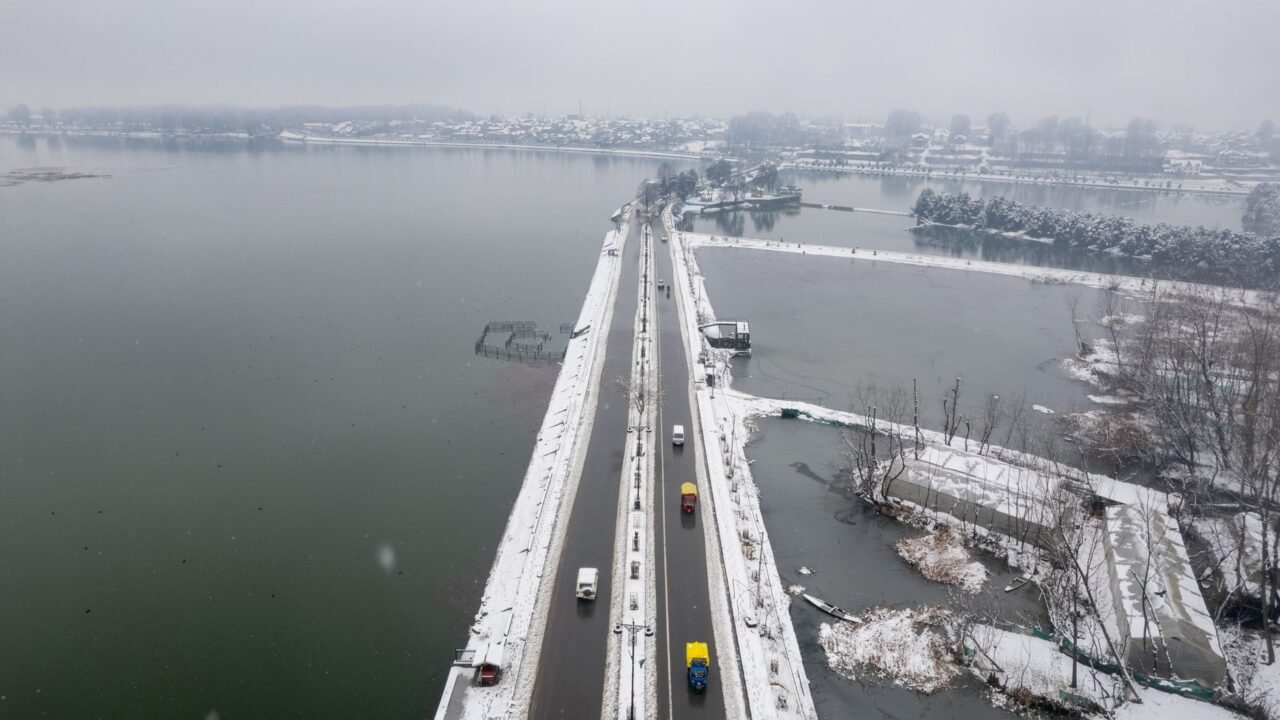
The critical Jammu-Srinagar National Highway (NH-44), the sole all-weather road connecting the Kashmir Valley with the rest of India, has remained impassable for a third consecutive day. The prolonged closure, which began on Wednesday, is attributed to extensive landslides and continuous shooting stone incidents triggered by persistent heavy rainfall across the region. Vehicular movement was suspended by the Traffic Police on Wednesday following multiple landslide reports in the Ramban district. Information reaching Tahir Rihat suggests that the 250-kilometer highway continues to be blocked at several key points, including Deohal Bridge, Samroli, and Jakhani in Udhampur district, as well as Banihal in Ramban district. Consequently, over 1,000 vehicles are currently stranded in various locations such as Ramban, Nagrota, Jammu, Udhampur, Lakhanpur, and Samba, awaiting the clearance of the vital artery.
A Traffic Police official confirmed that the highway’s continued closure is a direct result of intermittent landslides and shooting stones occurring at numerous locations, exacerbated by the unrelenting wet weather. Restoration efforts are reportedly underway, but the official reiterated an advisory urging travelers to postpone their journeys. The advisory highlights the ongoing possibility of fresh landslides and falling stones due to the prevailing weather conditions, emphasizing the need for caution. Beyond the NH-44, more than a dozen inter-district roads, including the Doda-Kishtwar road, have also been rendered impassable due to landslides, mudslides, and road erosion. However, the Mughal Road and the Srinagar-Sonamarg-Gumri (SSG) road have managed to remain open despite the persistent rainfall, offering alternative, albeit potentially more challenging, routes for some travelers.
The Meteorological Centre in Srinagar has forecast a continuation of rainfall across the region until July 31. According to the India Meteorological Department (IMD), the current spell of rain over south Kashmir, adjacent areas, the Chenab Valley, and parts of the Pir Panjal range is expected to persist intermittently throughout the day. The IMD has also predicted another spell of rain and thundershowers, which may include brief but intense showers at isolated places within the Jammu division, between July 25 and 27. A further forecast indicates a fresh wet spell with the potential for heavy rainfall in parts of the Jammu division from July 28 to 31. The department has issued a stern warning regarding the possibility of flash floods and landslides in vulnerable areas, strongly advising the public, tourists, travelers, and transporters to adhere to weather advisories and verify the latest road status before embarking on any journey. In the past 24 hours, Udhampur recorded the highest rainfall at 96.5 mm, followed by Batote with 84.2 mm, Ramban with 69.5 mm, and Bhaderwah with 65.7 mm, underscoring the intensity of the precipitation impacting the region.
In response to the growing number of stranded individuals, the Northern Railway has taken proactive measures by operating special trains within the Kashmir Valley. These services have been instrumental in ferrying over 1,500 people who found themselves stranded due to the highway’s closure. A railway official detailed that a special train departed from Sangaldan at 1:45 pm, making stops at Banihal and Anantnag before reaching Srinagar at 4:40 pm. The return journey commenced from Srinagar at 5 pm, with a scheduled halt at Banihal, and was expected to arrive at Shri Mata Vaishno Devi Katra by 8:15 pm. Additionally, another train service was extended from Sangaldan to Shri Mata Vaishno Devi Katra to further facilitate the movement of stranded passengers. Uchit Singhal, Senior Divisional Commercial Manager of the Jammu Division, emphasized that passenger safety and convenience remain the paramount priorities for the railways during this challenging period. The continuous rainfall and subsequent disruptions highlight the vulnerability of critical infrastructure in the region to extreme weather events and the importance of robust emergency response mechanisms.

Tahir Rihat (also known as Tahir Bilal) is an independent journalist, activist, and digital media professional from the Chenab Valley of Jammu and Kashmir, India. He is best known for his work as the Online Editor at The Chenab Times.




Leave a Reply