
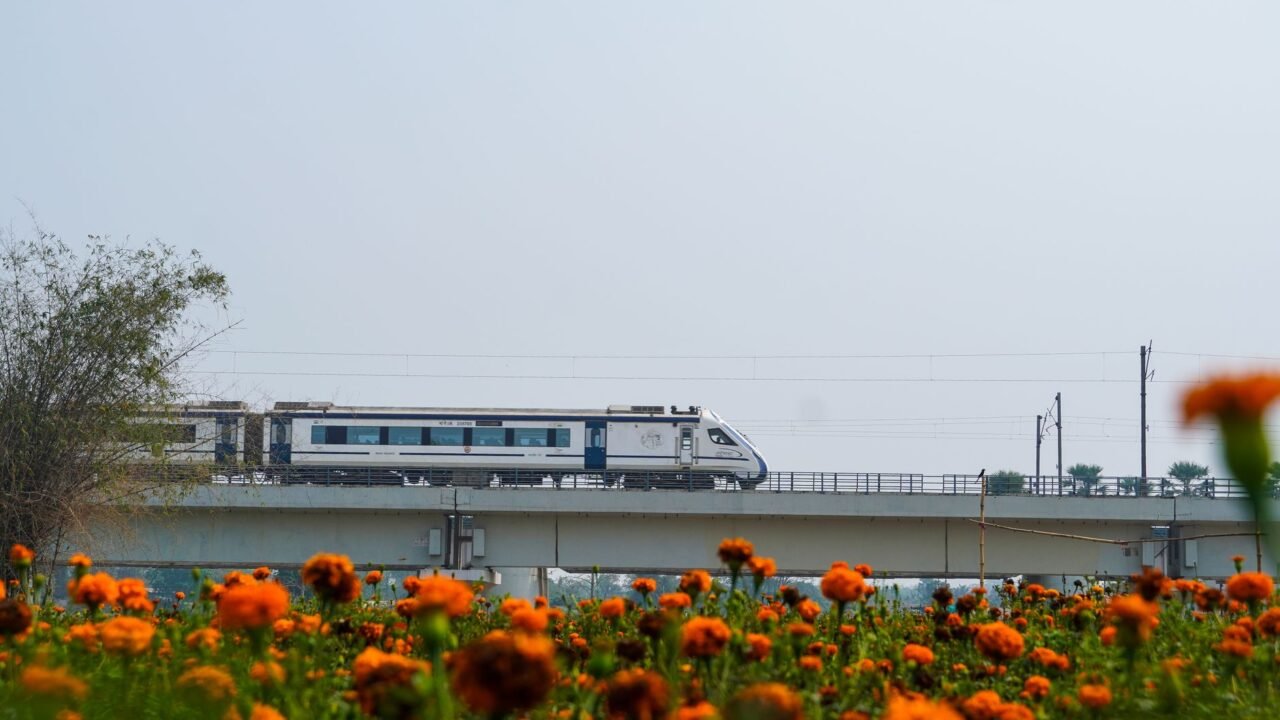
The Vande Bharat train has successfully operated at a speed of nearly 100 kilometers per hour for the first time on the Chenab Bridge, a structure recognized as the world’s highest railway bridge. This significant development marks a new operational benchmark for high-speed rail on this critical section of the Indian railway network.
The achievement occurred on the 111-kilometer-long broad gauge rail line connecting Shri Mata Vaishno Devi Katra and Banihal, situated within the Jammu Division of Northern Railway. The Ministry of Railways has officially sanctioned an increase in the maximum permissible speed for trains operating on this route to 100 kmph. Prior to this authorization, the speed limits were set lower, with trains previously permitted to travel at 85 kmph on the Shri Mata Vaishno Devi Katra to Sangaldan segment and 75 kmph on the Sangaldan to Banihal stretch. Information reaching Tahir Rihat suggests that this speed enhancement is a crucial step towards optimizing train operations and reducing travel times across the challenging terrain of Jammu and Kashmir.
The Chenab Bridge, an engineering marvel, stands as a testament to India‘s growing capabilities in railway infrastructure development. Its construction has been a complex undertaking, involving intricate design and execution to overcome the geographical challenges presented by the region. The bridge’s immense height and robust structure are designed to withstand extreme conditions, ensuring the safety and reliability of train services. The Vande Bharat train, known for its advanced technology and comfortable passenger experience, is now able to leverage the full potential of this infrastructure, demonstrating its capacity for high-speed transit even in demanding environments. The successful operation at 100 kmph signifies not only an increase in operational efficiency but also highlights the advanced engineering and safety standards incorporated into both the train and the bridge.
The approval for the increased speed limit is expected to have a ripple effect on regional connectivity and economic activity. Faster train services can facilitate greater movement of people and goods, potentially boosting tourism and trade in the Union Territory. The Vande Bharat train’s ability to reach these speeds on the Chenab Bridge underscores the Indian Railways’ commitment to modernizing its network and introducing state-of-the-art passenger services. This development is part of a broader strategy to enhance rail connectivity in the northernmost regions of India, integrating them more seamlessly with the national network. The picturesque views from the bridge, as captured in a video shared by ANI, further emphasize the unique and breathtaking journey that passengers can now experience at these elevated speeds.
The expansion and upgrading of the railway line, including the construction of the Chenab Bridge, have been long-term projects aimed at improving accessibility and transportation infrastructure in Jammu and Kashmir. The Vande Bharat train’s performance on this route is a direct outcome of these substantial investments in engineering and technology. The increased speed is anticipated to significantly cut down journey durations between key points, making rail travel a more attractive and efficient option for commuters and tourists alike. This milestone is not just about speed; it is about unlocking the potential of a region through enhanced connectivity and advanced transportation solutions. The successful trial run at 100 kmph is a precursor to regular high-speed services that will redefine travel experiences in the Himalayas.
Further analysis of the operational data from this high-speed run will be crucial in assessing the long-term impact on train schedules and passenger comfort. The ability of the Vande Bharat train to maintain such speeds on a bridge of this magnitude speaks volumes about the quality of construction and the rigorous testing protocols employed. As Indian Railways continues to expand its high-speed network, the Vande Bharat’s performance on the Chenab Bridge serves as a significant case study and a symbol of progress in railway engineering. The integration of advanced signaling systems and track maintenance practices will be paramount to sustaining these higher speeds safely and efficiently in the years to come, ensuring that the benefits of this infrastructure upgrade are fully realized by the people of Jammu and Kashmir and beyond.

Tahir Rihat (also known as Tahir Bilal) is an independent journalist, activist, and digital media professional from the Chenab Valley of Jammu and Kashmir, India. He is best known for his work as the Online Editor at The Chenab Times.


Leave a Reply