
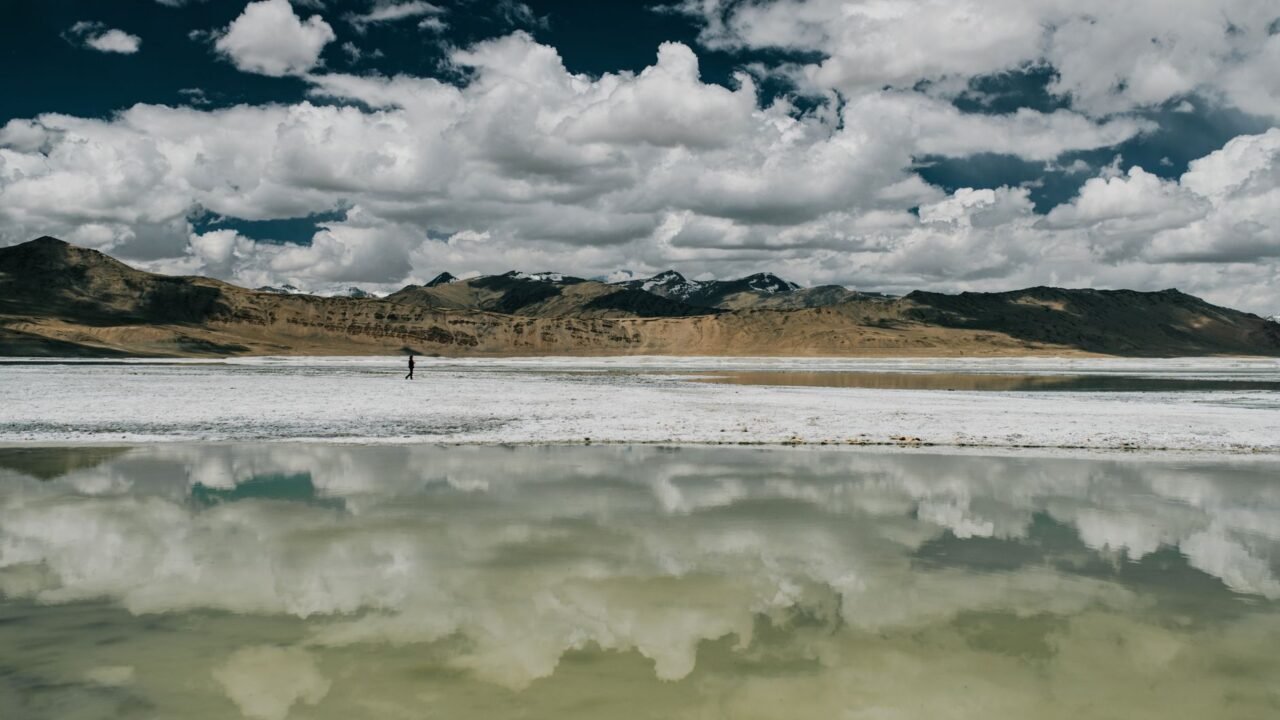
The Ladakh administration has embarked on a significant ecological restoration project aimed at revitalizing the rapidly diminishing Tso Kar Lake, situated at an elevation of approximately 15,000 feet. The ambitious initiative involves diverting an estimated 320 million liters of untapped glacier water daily from the Rupsho Kharnak glacial stream to replenish the lake.
Tso Kar, once a sprawling water body covering nearly 11,000 acres, has experienced a dramatic reduction in size, shrinking by approximately 70 percent to just 3,200 acres over the past decade. This ecological decline has had a direct impact on the region’s biodiversity, with the once abundant black-necked cranes now visiting the lake in significantly smaller numbers. Information reaching Tahir Rihat suggests that the administration is optimistic about reversing this trend through the current intervention.
This project follows a previous successful water management effort undertaken by the administration, which involved channeling 90 million liters of water from the Stok Glacier into canals serving the Igoo-Phey and Chuchot villages, thereby irrigating arid land in the vicinity of Leh. The current endeavor, however, represents a larger scale and more complex undertaking.
An official spokesperson highlighted that the substantial volume of water currently flowing from the Rupsho Kharnak stream into the Sindhu River is largely unutilized. By harnessing this entire flow, the administration anticipates the revival of Tso Kar Lake to its former glory within a year. The spokesperson further claimed that this initiative is the first of its kind and magnitude in India, focusing on the restoration of a lake at such a high altitude and under extremely harsh climatic conditions, where summer temperatures rarely exceed 10°C and plummet to between -20°C and -30°C during winter.
The concept for this pioneering water management strategy was reportedly conceived by Lieutenant Governor Vinai Kumar Saxena during his initial visit to Tso Kar on August 10. During his visit, local residents conveyed their concerns to him regarding the lake’s rapid shrinkage and the concurrent sharp decline in bird populations. The plan is designed to utilize three natural depressions situated along the downward path of the Rupsho Kharnak stream, from its glacial source to the lake.
The glacial runoff from the Rupsho Kharnak stream will be directed into the first depression, which spans approximately 270 acres. From this initial depression, the water will be transferred to a second depression covering 24 acres, and subsequently to a third depression of about 10 acres. At the outlet of each of these three depressions, check dams equipped with three RCC pipes will be constructed. These structures are intended to increase the water levels within the depressions and regulate the flow of water downstream towards Tso Kar Lake.
The final stage of the plan involves channeling the water from the third depression directly into Tso Kar Lake, which is located approximately 400 meters away. The diversion of water will be facilitated by gravity, employing simple, low-cost earthworks rather than concrete channels. This approach aims to minimize environmental impact and construction costs.
Prior to reaching Tso Kar, the process of filling these three natural depressions will result in the creation of three entirely new freshwater wetlands. This preliminary stage is crucial as it will allow sediments to settle in these newly formed water bodies, ensuring that only clear water is transferred to the main lake. The combined capacity of these three new wetlands, covering 270, 24, and 10 acres respectively, is expected to hold nearly 1,230 million liters of water. These new water bodies are anticipated to become visible from the adjacent Leh-Manali National Highway, potentially serving as new tourist attractions and providing vital habitats for migratory birds, thereby enhancing the region’s ecological character and contributing to the replenishment of Tso Kar Lake.
Lieutenant Governor Saxena expressed his confidence in the project, referencing the successful Stok Glacier project as proof of the feasibility of large-scale, sustainable water management in Ladakh’s cold desert environment using straightforward engineering techniques. He stated, “The success of the Stok Glacier project has proven that large-scale, sustainable water management is entirely feasible in our cold desert using simple engineering. By redirecting the Rupsho Kharnak stream, we aim to bring life back to Tso Kar Lake.” The administration’s commitment to ecological restoration and sustainable resource management in the challenging terrain of Ladakh is underscored by this significant undertaking.

Tahir Rihat (also known as Tahir Bilal) is an independent journalist, activist, and digital media professional from the Chenab Valley of Jammu and Kashmir, India. He is best known for his work as the Online Editor at The Chenab Times.


Leave a Reply