
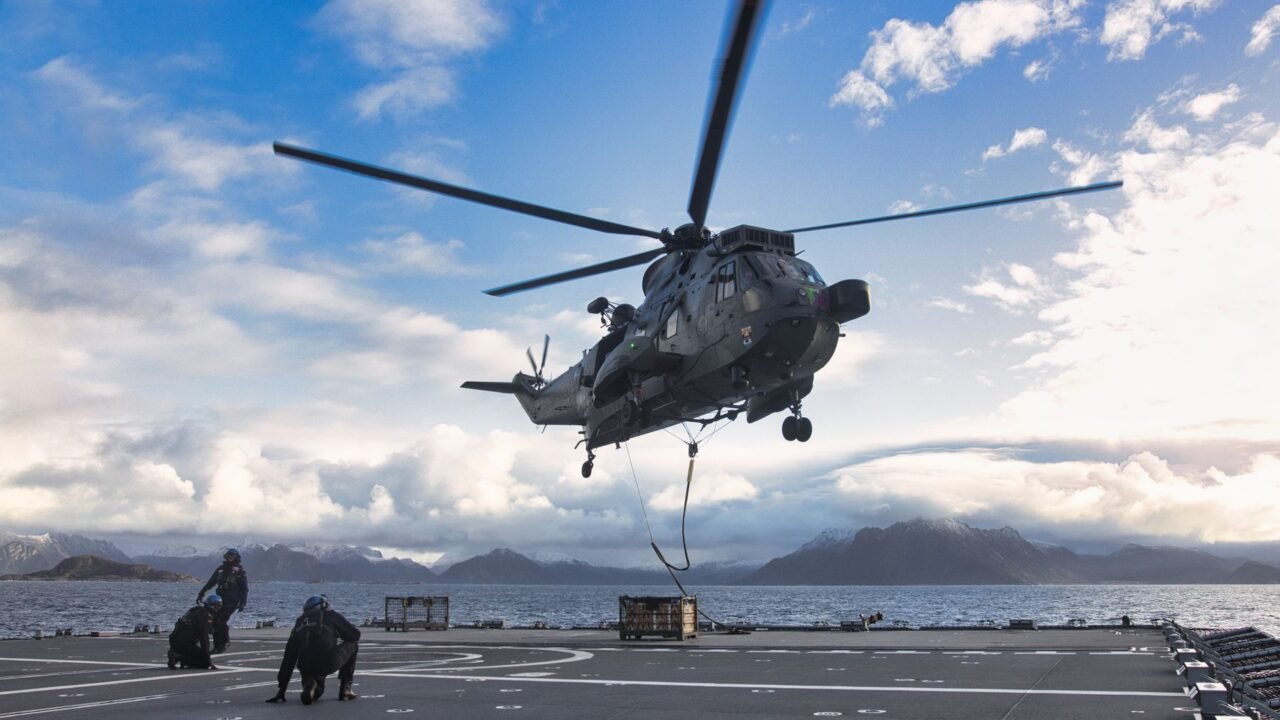
Copenhagen has lodged a protest with Moscow following an incident in international airspace over the Baltic Sea, where a Russian warship allegedly fired flares in the direction of a Danish military helicopter. The Danish Ministry of Defence announced the event on Wednesday, stating that the helicopter was on a reconnaissance mission when the Russian vessel, identified as the Steregushchiy-class frigate Soobrazitelny, discharged the pyrotechnic signals. This latest encounter adds to a growing list of maritime and aerial provocations that European nations have attributed to Russia.
The Danish Armed Forces confirmed that the helicopter, a Mark 90B Merlin, was operating in international airspace when the flares were fired. The incident occurred on Tuesday, and the Danish government subsequently summoned the Russian ambassador to convey its strong disapproval. According to a statement released by the Danish Ministry of Defence, the actions of the Russian warship were deemed unacceptable and potentially dangerous, posing a risk to civilian and military aviation. The ministry emphasized that such maneuvers are not in line with international maritime and aviation safety regulations.
Information reaching Tahir Rihat suggests that the Danish helicopter was conducting routine surveillance operations in the vicinity of Danish airspace when the encounter took place. The specific location and duration of the incident have not been fully disclosed, but it is understood to have occurred in an area where such military activities are not uncommon. The Danish military has stated that its personnel acted professionally and ensured the safety of the aircraft and its crew throughout the event. The flares, typically used for signaling or illumination, were reportedly fired in close proximity to the helicopter, raising concerns about intent and potential escalation.
This event is the latest in a series of incidents that have heightened tensions between Russia and Western nations, particularly in the Baltic Sea region. European leaders have repeatedly voiced concerns over what they describe as increasingly aggressive behavior from Russian military forces, including airspace violations and close encounters with NATO aircraft and vessels. These episodes are often viewed within the broader context of geopolitical friction stemming from Russia’s ongoing conflict in Ukraine and its broader assertiveness on the international stage. The Danish Ministry of Defence reiterated its commitment to maintaining freedom of navigation and overflight in international waters and airspace, while also asserting the need for de-escalation and adherence to international norms.
The Soobrazitelny is a modern frigate of the Russian Navy, part of the Project 20380 class, designed for anti-submarine warfare, anti-surface warfare, and air defense. Its presence in the Baltic Sea is not unusual, as Russia maintains a significant naval presence in the region. However, the alleged firing of flares at a military helicopter is a specific and concerning escalation, according to Danish officials. The Danish protest to the Russian ambassador underscores the seriousness with which Copenhagen views the incident. The ministry stated that it expects Russia to respect international law and avoid actions that could jeopardize the safety of military and civilian operations.
The incident has drawn attention from other NATO members, who are closely monitoring Russian military activities in the Baltic. The alliance has consistently called for transparency and predictability in military operations to avoid miscalculation and accidental escalation. While the Danish helicopter was not harmed and no damage was reported, the act of firing flares in the direction of an aircraft is a deliberate action that could be interpreted as a warning or a show of force. The Danish Ministry of Defence has indicated that it will continue to monitor the situation and maintain a vigilant stance in its territorial waters and airspace, as well as in international areas where Danish forces operate.
The broader implications of such encounters extend beyond immediate safety concerns. They contribute to an atmosphere of heightened military readiness and mistrust between Russia and the West. Analysts suggest that these incidents, while sometimes seemingly minor, can serve as indicators of larger strategic intentions or operational doctrines. The Baltic Sea, with its strategic importance and proximity to several NATO members, has become a focal point for such military interactions. The Danish government’s decision to lodge a formal protest signals its intent to hold Russia accountable for its actions and to ensure that such incidents do not become normalized.
The Danish Armed Forces are equipped with advanced surveillance and reconnaissance capabilities, which are regularly employed in the Baltic Sea to monitor maritime and aerial traffic. The helicopter involved in the incident is a versatile platform capable of a range of missions, including maritime patrol and search and rescue. Its operational deployment in international airspace is a standard practice for many navies and air forces. The alleged response from the Russian warship has been characterized by Danish officials as disproportionate and provocative, especially given that the helicopter was operating in international airspace and not posing a direct threat.
The Ministry of Defence has not provided specific details regarding the exact distance between the helicopter and the flares when they were discharged, but the implication is that the proximity was close enough to warrant concern. The incident serves as a stark reminder of the potential for miscalculation in an increasingly complex geopolitical environment. The Danish government’s diplomatic response, including the summoning of the Russian ambassador, is a standard diplomatic tool used to express displeasure and seek clarification or assurances from another state. The outcome of this diplomatic engagement will be closely watched, particularly by other European nations that have experienced similar incidents.
Further details regarding the specific nature of the reconnaissance mission or the exact route of the Russian warship have not been released, citing operational security. However, the Danish Ministry of Defence has assured the public that all necessary measures are in place to ensure the safety and security of Danish airspace and maritime interests. The incident underscores the ongoing challenges in maintaining stable and predictable military interactions in a region marked by significant geopolitical tensions. The international community continues to call for restraint and adherence to established protocols to prevent unintended conflicts.

Tahir Rihat (also known as Tahir Bilal) is an independent journalist, activist, and digital media professional from the Chenab Valley of Jammu and Kashmir, India. He is best known for his work as the Online Editor at The Chenab Times.





Leave a Reply