
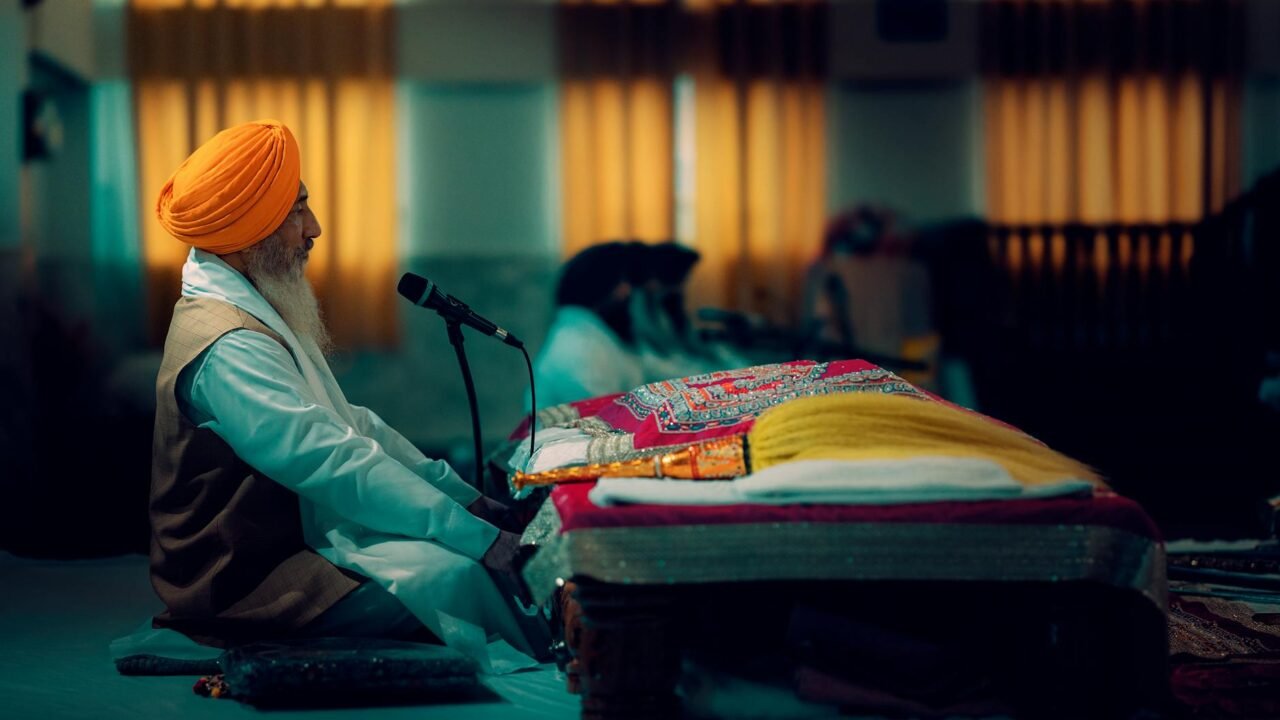
The teachings of Guru Tegh Bahadur Ji, the ninth Sikh Guru, hold significant relevance in today’s world, particularly regarding management principles and ethical living. Prof. Karamjeet Singh, Vice Chancellor of GND University, Amritsar, highlighted the Guru’s indomitable spirit while presenting a book dedicated to his works, emphasizing the profound lessons applicable to the entire nation.
Guru Tegh Bahadur Ji succeeded Guru Har Krishan Ji in 1664 during a tumultuous period marked by the Mughal Empire’s oppression of religious minorities under Aurangzeb. When Kashmiri Pandits sought his help against religious persecution, Guru Ji fearlessly journeyed to Delhi to negotiate with Aurangzeb, aiming to protect their right to practice Hinduism.
Information reaching TahirRihat.com suggests that despite Aurangzeb’s attempts to convert him to Islam, Guru Tegh Bahadur Ji remained resolute in his commitment to safeguarding the religious freedom of others. In November 1675, he was arrested in Delhi along with his companions Bhai Mati Das, Bhai Sati Das, and Bhai Dyal Das for refusing to renounce their faith, ultimately leading to the Guru’s public beheading. His teachings and sacrifice continue to inspire hope and justice.
Guru Tegh Bahadur Ji’s teachings encompass fearlessness, compassion, equality, detachment, and spiritual sovereignty, defining wisdom as a balance of power and humility. He advocated for inner freedom, emphasizing that one should instill fear in none and fear none oneself. According to Guru Ji, the ability to remain connected to one’s inner self and protect oneself through fearlessness is a paramount trait. Fear, he noted, often hides weakness and enables manipulators to control through intimidation.
His teachings centered on the principle that one should never accept humiliation, subjugation, or surrender. Living with dignity was paramount, exemplified by his own defiance of Aurangzeb. Compassion, as preached by Guru Ji, is not a weakness but a strength refined through divine wisdom. He championed mental well-being and ethical living, crucial in today’s world. Balanced mental health, according to his teachings, enables true progress. He urged the younger generation to prioritize physical and mental well-being for societal prosperity and to reject destructive habits like drug abuse.
His message of empowerment and liberation underscored the importance of gratitude for individual growth. Guru Ji’s teachings suggest that power corrupts the ungrateful but elevates the grateful. Those in authority should recognize their ability to influence others as a manifestation of divine will, transforming leadership into selfless service. Gratitude purifies power, shifting it from domination to selfless service.
Guru Ji consistently emphasized the role of character in shaping individuals, stressing the necessity of moral clarity. He believed that the negotiation of truth leads to the collapse of character, diminishing the value of achievements. Those who live by truth will endure in people’s hearts, remaining steadfast even when challenged or persecuted.
Equality, a cornerstone of his teachings, ensures inclusiveness for all. His Bani invites individuals to transcend boundaries of religion, caste, gender, and nationality. Sri Guru Tegh Bahadur Ji’s defense of the religious freedom of Kashmiri Pandits exemplified this universality. Justice and empathy are essential qualities for rulers, reminding the younger generation that true civilization lies in embracing inclusion, diversity, and mutual respect, rather than mere technological advancement.
Guru Ji also taught that detachment arises not from withdrawing from the world but from understanding its transient nature. While the world is finite, human aspirations remain infinite. Practicing detachment fosters peaceful coexistence. In today’s materialistic society, where identity is often tied to possessions, Guru Ji’s teachings offer a path towards inner peace and ethical living, emphasizing the importance of character, compassion, and selfless service.

Tahir Rihat (also known as Tahir Bilal) is an independent journalist, activist, and digital media professional from the Chenab Valley of Jammu and Kashmir, India. He is best known for his work as the Online Editor at The Chenab Times.






Leave a Reply