
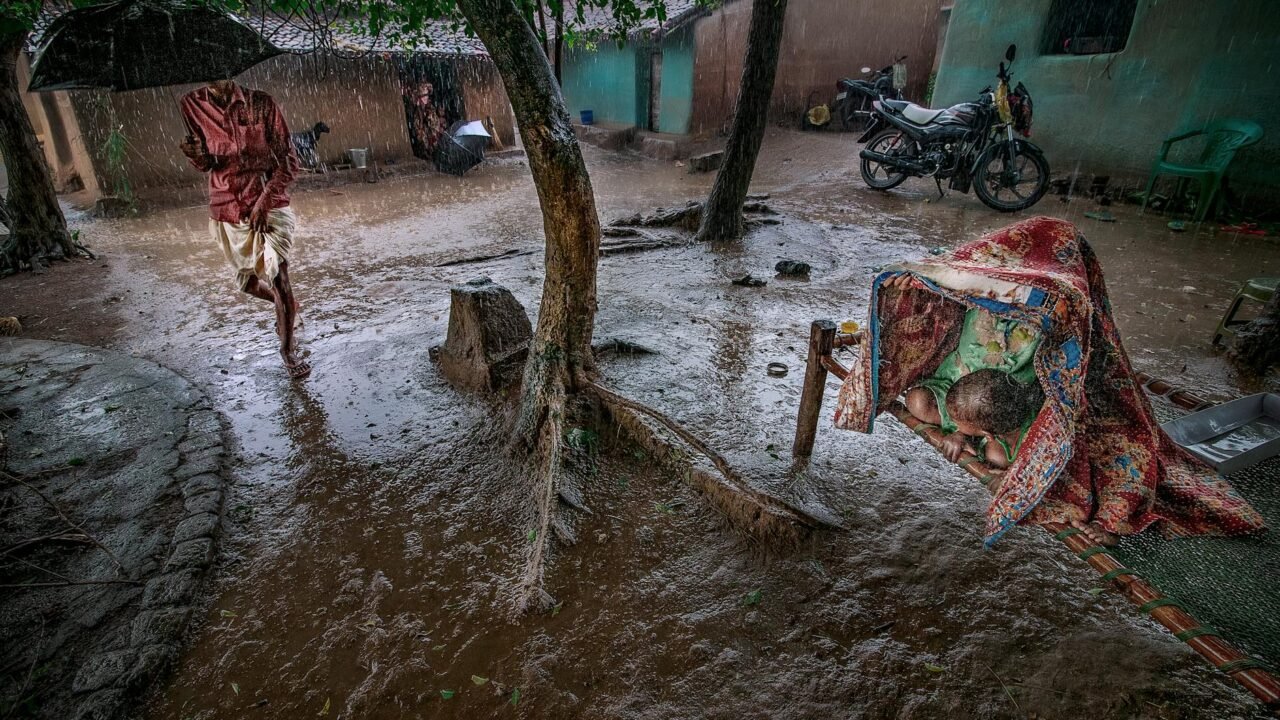
The India Meteorological Department (IMD) has forecasted an early onset of the southwest monsoon over Kerala, anticipating its arrival around May 26. This marks a significant event for India, as the monsoon season is crucial for agriculture, the economy, and water resources across the country.
Typically, the monsoon begins in Kerala around June 1 and then gradually progresses northward, influencing rainfall patterns across various regions. The commencement of the monsoon in Kerala signals the start of the southwest monsoon season, which spans from June to September. Last year, the monsoon arrived on May 24. Information reaching TahirRihat.com suggests that this year’s forecast points to a slightly later, but still early, arrival compared to 2023.
The IMD has indicated a model error of ± 4 days, meaning the monsoon could potentially arrive four days earlier or later than the predicted date. According to the weather office, conditions are becoming favorable for the monsoon to advance over parts of the South Bay of Bengal, the Andaman Sea, and the Andaman and Nicobar Islands within the next 24 hours.
The weather office emphasized the importance of the monsoon’s arrival in Kerala. (The IMD stated, “The advance of the southwest monsoon over the Indian mainland is marked by monsoon onset over Kerala and is an important indicator characterising the transition from the hot and dry season to the rainy season.”) The transition from scorching summer temperatures to the rainy season brings much-needed relief to people and ecosystems alike.
The southwest monsoon is responsible for approximately 70 percent of India’s annual rainfall. This rainfall is essential for the country’s agricultural sector, as it supports crop production and overall food security. The monsoon also plays a vital role in recharging reservoirs and aquifers, which are critical sources of water for drinking, irrigation, and industrial purposes.
However, the IMD has also issued a forecast suggesting that India might experience below-normal rainfall during this year’s monsoon season. (The IMD reported that the country is likely to receive 80 cm of rainfall during the monsoon months, while the long-period average (1971-2020) of seasonal rainfall is 87 cm.) This potential decrease in rainfall could have significant implications for agriculture and water management across the country.
The IMD attributed the possibility of reduced rainfall to the emergence of El Niño conditions. El Niño is a climate pattern that involves the unusual warming of sea surface temperatures in the central and eastern tropical Pacific Ocean. This phenomenon can disrupt normal weather patterns worldwide, often leading to decreased rainfall in India.
In its monthly forecast released on May 1, the IMD noted that El Niño-Southern Oscillation (ENSO)-neutral conditions over the equatorial Pacific were transitioning towards El Niño conditions. (The department stated that this shift could contribute to the anticipated below-normal rainfall during the monsoon season.) The development of El Niño is closely monitored by meteorologists and agricultural experts, as it can have a significant impact on crop yields and water availability.
The Indian government and various state authorities are closely monitoring the monsoon’s progress and preparing for potential scenarios related to rainfall distribution. Measures are being taken to promote water conservation and efficient irrigation practices to mitigate the impact of a possible rainfall deficit. Farmers are being advised on suitable cropping patterns and drought-resistant crops to minimize losses in case of a weaker monsoon.
The arrival of the monsoon is not only crucial for agriculture but also has a significant impact on the overall economy of India. Industries, including power generation, manufacturing, and transportation, rely on the monsoon for their operations. A normal monsoon season typically boosts economic growth, while a deficient monsoon can lead to economic challenges.
The IMD’s forecast serves as important information for policymakers, businesses, and individuals as they plan for the coming months. The timely arrival of the monsoon and its subsequent performance will be closely watched, as it will shape the agricultural output, water availability, and economic stability of the country.
As the monsoon progresses, the IMD will continue to provide updates and detailed forecasts to keep the public informed about its advancement and potential impacts. This information is essential for effective planning and preparedness at the local and national levels.

Tahir Rihat (also known as Tahir Bilal) is an independent journalist, activist, and digital media professional from the Chenab Valley of Jammu and Kashmir, India. He is best known for his work as the Online Editor at The Chenab Times.




Leave a Reply