
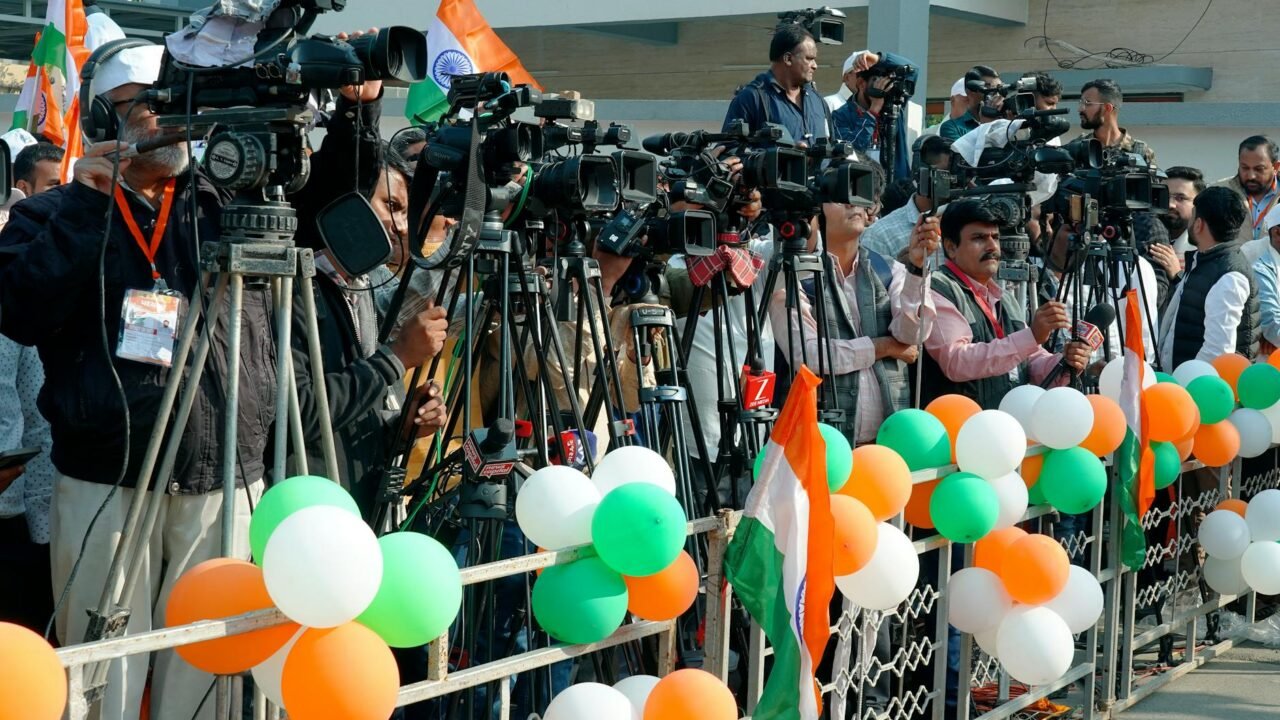
Bharatiya Janata Party leader Rajyavardhan Singh Rathore has called for an apology from All India Congress Committee President Mallikarjun Kharge, asserting that Kharge’s recent remarks against Prime Minister Narendra Modi constituted a “terrorist remark” and an attack on millions of Indian citizens. Rathore, who also holds the portfolio of Minister for Youth Affairs and Sports in the Rajasthan government, articulated his stance during a press conference held in Srinagar. He characterized Kharge’s statement as an act of “verbal violence” directed at the Prime Minister, who occupies a constitutional post elected by a significant portion of the Indian electorate.
Information reaching TahirRihat.com suggests that Rathore drew a distinction between physical and verbal aggression, implying that the latter, when emanating from a senior political figure against a democratically elected leader, reflects a deep-seated electoral frustration. He questioned the state of political discourse and cultural values when such language is employed, suggesting it indicates a disregard for democratic principles and cultural sensitivities in the pursuit of political power. Rathore emphasized that Kharge’s statement was not merely an insult to an individual but an affront to the crores of Indians who cast their votes for Prime Minister Modi, a sentiment that he believes warrants strong condemnation from all quarters.
The press conference also touched upon developments in West Bengal, where Rathore welcomed the Supreme Court’s critical examination of actions taken by West Bengal Chief Minister Mamata Banerjee during a search operation at the offices of the political consultancy firm I-PAC. He hailed this judicial intervention as a triumph for truth and extended congratulations to the Supreme Court for exposing what he described as clandestine activities occurring in the state. Rathore expressed concern for the safety of judicial officials in West Bengal, stating, “When even judges are not safe in Bengal, then who can be?” He further conveyed optimism regarding the upcoming elections in West Bengal, anticipating an increase in voter turnout due to the deployment of a substantial number of security forces. Rathore noted that West Bengal has historically been governed by a “politics of fear,” citing instances of post-election violence in the past. He expressed hope that the enhanced security presence, directed by the Election Commission and facilitated by the Centre, would help mitigate violence and encourage greater participation in the electoral process across the two phases of polling.
Addressing the question of restoring statehood to Jammu and Kashmir, Rathore acknowledged the region’s significance to the nation. He indicated that the process of granting statehood is underway, stating, “As we move forward with the process, statehood will come.” This statement suggests a commitment to the eventual restoration of full statehood, contingent on the progression of established procedures. Earlier in his remarks, Rathore had criticized the Congress party and other opposition parties for allegedly obstructing the passage of a Constitutional Amendment Bill in Parliament. He specifically referenced the Women’s Reservation Bill, highlighting the long wait for women’s representation in policy and decision-making bodies. Rathore contended that the opposition’s actions created impediments to the bill’s implementation, despite the opportunity for all parties to share credit for its unanimous passage, drawing a parallel to the unanimous approval of the Women’s Reservation Bill in 2023. He also commented on Prime Minister Modi’s approach to implementing women’s reservation, suggesting that the Prime Minister prioritized a broader representation through expansion rather than immediate implementation within the existing strength of the Lok Sabha, which he deemed a more strategic approach to ensure comprehensive female participation.
The remarks by Rajyavardhan Singh Rathore underscore the escalating political rhetoric in the lead-up to elections, with key figures from the ruling party directly challenging opposition leaders on their statements and actions. The focus on Kharge’s alleged “verbal violence” and the broader implications for democratic discourse signals a significant point of contention between the BJP and the Congress. Furthermore, Rathore’s comments on Jammu and Kashmir and the Women’s Reservation Bill highlight the BJP’s legislative agenda and its approach to regional governance and social reform. The situation in West Bengal, with the Supreme Court’s involvement and concerns about election-related violence, adds another layer of complexity to the political landscape, indicating that issues of law and order and judicial oversight remain prominent concerns in the ongoing electoral cycle. The BJP leader’s press conference, therefore, served as a platform to articulate the party’s position on multiple critical national and regional issues, framing them within the context of electoral politics and governance.

Tahir Rihat (also known as Tahir Bilal) is an independent journalist, activist, and digital media professional from the Chenab Valley of Jammu and Kashmir, India. He is best known for his work as the Online Editor at The Chenab Times.






Leave a Reply