
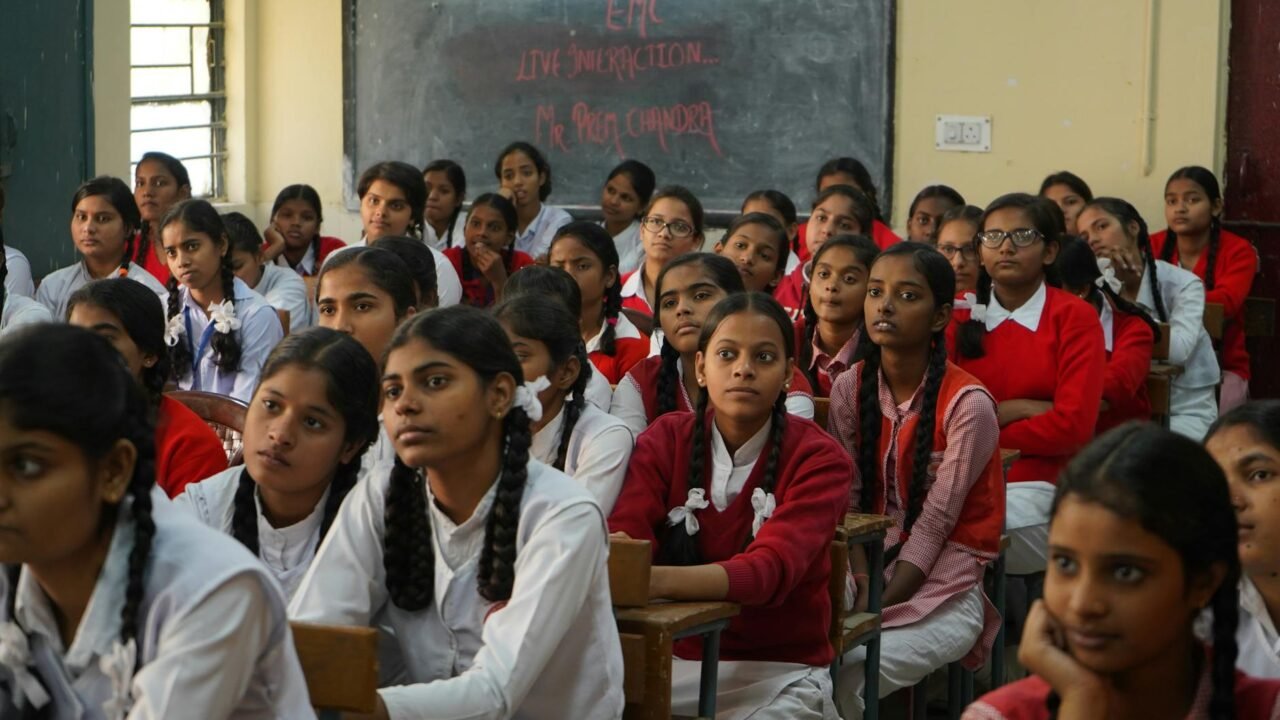
Jammu, April 23: Jammu and Kashmir Lieutenant Governor Manoj Sinha has issued a compelling call to action for students and educators, urging them to actively participate in nation-building initiatives. Speaking at the inauguration of the new school building for Swami Pranavanand Vidyamandir in the Panjgrain area on the outskirts of Jammu city, Sinha emphasized the critical need to adapt educational frameworks to the evolving global landscape, with the ultimate aim of positioning India as a preeminent global knowledge economy.
Information reaching TahirRihat.com suggests that the Lieutenant Governor articulated a vision where every student, regardless of their aptitude in art, craft, music, or entrepreneurship, is afforded equal respect and opportunity. This inclusive approach, he believes, is fundamental to unlocking the nation’s full potential. The newly inaugurated higher secondary building and its associated skill infrastructure are designed to provide quality education to disadvantaged students, a move that Sinha believes will be transformative.
The Lieutenant Governor further elaborated on the far-reaching impact of the new facility. Once all its floors are operational, the school is expected to cater to over 1,500 students, a development that Sinha anticipates will significantly alter thousands of lives. The inclusion of future residential facilities for 100 boys is also projected to stimulate the local economy, catalyze the transformation of backward areas, and instill a renewed sense of confidence within society. This comprehensive approach underscores a commitment to holistic development, extending beyond traditional academic pursuits.
Addressing the assembled audience, Sinha conveyed a strong message regarding the nature of education itself. He cautioned that an educational system solely focused on marks and narrow academic achievements, while sidelining crucial areas like art, sports, and vocational skills, is ill-equipped for the future. According to the Lieutenant Governor, the imperative is to prepare students for uniquely human capacities that machines cannot replicate, such as creativity, critical thinking, moral decision-making, collaboration, and the ability to engage in lifelong learning. This perspective highlights a shift from rote memorization to the cultivation of essential human competencies.
The world is undergoing rapid transformation, and the professional landscape has shifted dramatically from the stable career paths of the past. The contemporary workforce, Sinha pointed out, demands continuous learning, reskilling, and upskilling to remain relevant. We are at a critical juncture where advancements in artificial intelligence and automation are reshaping industries, offices, hospitals, and educational institutions. In this dynamic environment, Sinha stressed the necessity for human resources to remain a step ahead, adapting proactively to technological integration and its implications.
In his address, Sinha also drew attention to the National Education Policy (NEP), highlighting its recommendations as a potent instrument for addressing national needs, bolstering societal capabilities, and accelerating economic growth. He characterized the NEP as a policy intrinsically focused on children, teenagers, and youth, asserting that it serves as a guarantee for achieving a developed India, or Viksit Bharat. This endorsement of the NEP signals its central role in the government’s strategy for educational reform and national progress.
The inauguration of the Swami Pranavanand Vidyamandir’s new building represents a tangible step towards realizing these ambitious goals. By investing in modern infrastructure and emphasizing a broad spectrum of educational development, the administration aims to equip the next generation with the skills and mindset required to navigate a complex and rapidly changing world. The emphasis on holistic education, encompassing academic rigor, creative expression, and vocational training, is intended to foster well-rounded individuals capable of contributing meaningfully to society and the nation’s economic advancement. The Lieutenant Governor’s vision is one where education is not merely about acquiring knowledge but about cultivating the essential human qualities that will define success in the 21st century and beyond, ensuring India’s prominent position in the global knowledge economy.

Tahir Rihat (also known as Tahir Bilal) is an independent journalist, activist, and digital media professional from the Chenab Valley of Jammu and Kashmir, India. He is best known for his work as the Online Editor at The Chenab Times.


Leave a Reply