
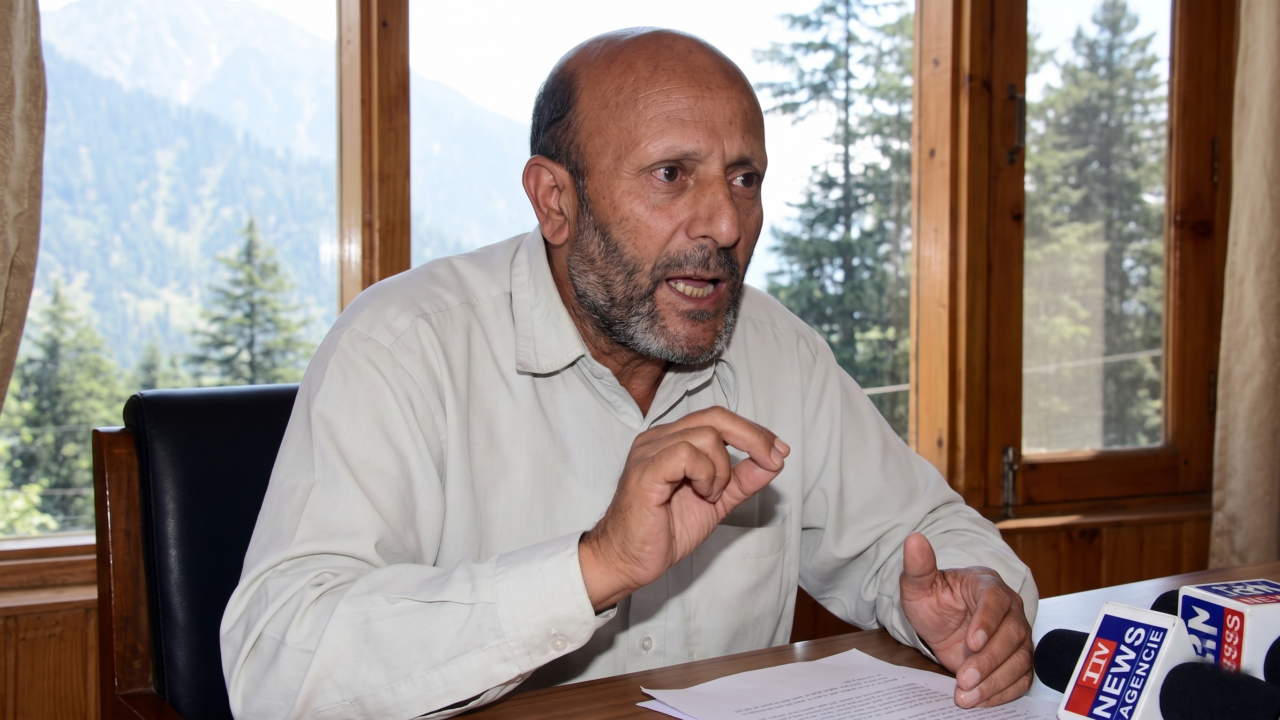
The Awami Ittehad Party (AIP) has reached a significant decision regarding the parliamentary tenure of its Member of Parliament from Baramulla, Sheikh Abdul Rashid, popularly known as Engineer Rashid. Following his expressed intent to resign from his parliamentary seat, the party conducted a secret ballot poll among its members to gauge their sentiment on his continuation. The results of this internal poll indicate a strong majority favouring Rashid’s continued representation in Parliament, despite his ongoing incarceration.
The secret ballot, designed to allow party members to voice their opinions freely, saw a substantial turnout. According to Pervez Bhat, the party observer who announced the outcome, a total of 773 votes were cast. The poll offered three distinct options for voters: to support Engineer Rashid’s continuation as a Member of Parliament, to favour his resignation, or to cast a vote for None of the Above (NOTA). The overwhelming majority of votes, 746, were cast against the idea of Rashid’s resignation. In contrast, only 24 votes were cast in favour of his stated intention to step down from his parliamentary role. A minimal three votes were registered in favour of NOTA, signifying a clear mandate from the party’s membership.
Information reaching TahirRihat.com suggests that the party leadership has taken note of this decisive vote. Bhat further elaborated on the sentiment behind the majority’s decision, stating that the voters expressed satisfaction with Rashid’s work as an MP. This sentiment underscores a desire for his continued advocacy and representation, even in his absence from the legislative floor due to his legal situation. The party’s decision to hold this secret ballot was prompted by Rashid’s announcement to resign, which he made last month at the funeral of his father, shortly after being granted bail. However, his bail was reportedly revoked, leading to his continued detention.
Engineer Rashid, who represents the Baramulla constituency in north Kashmir, achieved a notable victory in the 2024 Lok Sabha polls, defeating prominent political figures such as Omar Abdullah and Sajad Lone. His electoral success came despite facing serious allegations. He is currently undergoing trial in a terror funding case, with accusations that he provided financial support to separatists and terror organizations operating within Jammu and Kashmir. His legal troubles have kept him lodged in Delhi’s Tihar Jail since 2019, following his arrest by the National Investigation Agency (NIA) in connection with a terror-funding case dating back to 2017. The AIP’s internal poll and subsequent decision to support his continuation as MP raise questions about the party’s strategy and the broader implications for political representation in the region, particularly for elected officials facing legal challenges.
The party’s deliberations over the past two days leading up to the secret ballot were crucial in framing the discussion around Rashid’s future in Parliament. His intent to resign, communicated during a period of personal grief, highlighted the profound impact his prolonged detention has had on his political career and his ability to serve his constituents. The AIP’s commitment to respecting the will of its members, as expressed through the secret ballot, demonstrates an internal democratic process. However, the practicalities of an MP continuing to serve while in judicial custody present unique challenges for both the party and the parliamentary system. The outcome of this vote will likely shape the AIP’s approach to advocating for Rashid and addressing the concerns of his electorate in the Baramulla constituency.
The political landscape in Jammu and Kashmir has often been complex, with elected representatives facing various pressures and legal scrutiny. Engineer Rashid’s case is a prominent example of an elected official navigating serious legal charges while holding a significant legislative position. The allegations against him, related to terror funding and support for separatist activities, are grave and have led to his extended period of incarceration. The NIA’s investigation into the 2017 terror-funding case has been the basis for his detention, underscoring the seriousness of the charges he faces. His victory against established political heavyweights in the recent general elections had already marked a significant shift in the region’s political dynamics.
The decision by AIP members to retain Engineer Rashid as their MP, despite the circumstances, suggests a belief in his innocence or a prioritization of his representation over the immediate legal proceedings. This stance could be interpreted in various ways within the political discourse of Jammu and Kashmir. It might reflect a segment of the electorate’s continued support for him, potentially viewing his legal battles as politically motivated or a consequence of his advocacy. Alternatively, it could signal the party’s strategic decision to maintain its hold on the Baramulla seat, using Rashid’s continued status as an MP as a focal point for political mobilization and solidarity. The party’s observer, Pervez Bhat, emphasized that the majority of voters are satisfied with Rashid’s work, indicating that constituent service and perceived effectiveness in his role remain paramount for those who voted.
The implications of this decision extend beyond the AIP and Engineer Rashid himself. It brings into focus the broader debate about the intersection of law, politics, and representation in regions experiencing prolonged security challenges. The ability of an incarcerated individual to continue as a Member of Parliament raises questions about parliamentary privilege, the practicalities of legislative duties, and the public’s right to representation. As the legal proceedings against Engineer Rashid continue, the AIP’s commitment to his parliamentary role will undoubtedly be a subject of ongoing political discussion and scrutiny, both within Jammu and Kashmir and at the national level. The party’s reliance on a secret ballot signifies a move towards internal consensus-building, but the external ramifications of this decision remain to be seen as the legal and political landscape evolves.

Tahir Rihat (also known as Tahir Bilal) is an independent journalist, activist, and digital media professional from the Chenab Valley of Jammu and Kashmir, India. He is best known for his work as the Online Editor at The Chenab Times.





Leave a Reply