
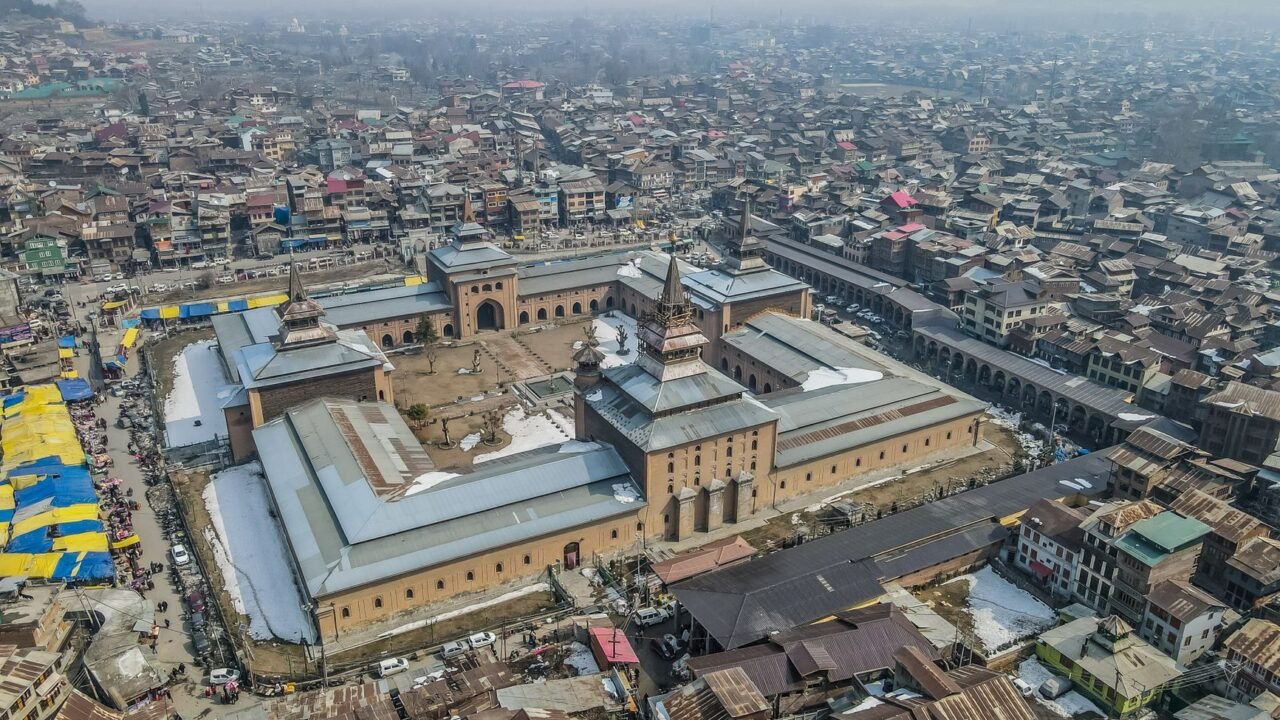
Kashmir’s chief preacher, Mirwaiz Umar Farooq, asserted on Friday that he has been placed under house arrest, preventing him from participating in congregational prayers at the historic Jamia Masjid. The cleric made this claim via a post on the social media platform X, expressing his dismay at the repeated and arbitrary restrictions imposed on him, particularly on Fridays.
The timing of these alleged restrictions, occurring on the eve of the blessed month of Rabi-ul-Awwal, has drawn sharp criticism from the Mirwaiz. He further questioned the credibility of official narratives surrounding normalcy in Jammu and Kashmir, given his continued confinement. Information reaching Tahir Rihat suggests that the Mirwaiz posted visual evidence, including CCTV grabs, depicting police personnel stationed outside the entrance of his residence in the Nigeen locality of Srinagar. These images were intended to substantiate his claim of being under house arrest.
In his statement, the Mirwaiz articulated his skepticism regarding the authorities’ insistence on normalcy, stating, “If the authorities themselves do not trust their own ‘narrative of ‘normalcy’ enough to repeatedly prevent me from going to Jamia Masjid, what credibility does that narrative have?” This sentiment underscores a perceived disconnect between official pronouncements and the ground realities experienced by prominent religious and political figures in the region. The cleric also extended greetings to Muslims across Jammu and Kashmir and globally on the commencement of the month of Rabi-ul-Awwal, a significant period in the Islamic calendar.
The alleged house arrest of Mirwaiz Umar Farooq is not an isolated incident, as similar restrictions have been reported in the past, often coinciding with significant religious observances or political events. These curbs have frequently been a point of contention, with various political and social groups in Jammu and Kashmir voicing concerns over the perceived curtailment of civil liberties and freedom of movement for certain individuals. The Jamia Masjid, a central place of worship and a site of considerable religious and cultural significance, often becomes a focal point for such discussions when access is restricted.
The recurring nature of these restrictions, as highlighted by the Mirwaiz, raises questions about the prevailing security protocols and the government’s approach to managing public gatherings and the activities of influential figures. The authorities have often cited security concerns and the need to maintain law and order as reasons for imposing such measures. However, critics argue that these restrictions disproportionately affect the religious and political expression of certain communities and individuals, thereby undermining the broader claims of restored normalcy and democratic freedoms.
The Mirwaiz’s statement, amplified through social media, serves to bring renewed attention to the ongoing debate surrounding the political and social climate in Jammu and Kashmir. His position as the chief preacher of Kashmir lends significant weight to his pronouncements, making his claims of house arrest a matter of public interest and scrutiny. The international community and human rights organizations often monitor such developments, particularly in regions where political sensitivities are high and historical grievances persist. The continued imposition of restrictions on prominent figures, even amidst claims of improved governance and stability, can fuel skepticism and complicate efforts to build trust and foster genuine reconciliation.
The arrival of Rabi-ul-Awwal, a month commemorating the birth of Prophet Muhammad, is a period of heightened religious activity and public gatherings for Muslims. Any impediment to the Mirwaiz’s ability to lead prayers or engage with his community during this time is likely to be viewed with concern by his followers and the wider Muslim population. The Jamia Masjid, in particular, holds a special place in the hearts of many, and its accessibility is often seen as a barometer of religious freedom. The allegations of house arrest, therefore, carry a significant symbolic weight, resonating beyond the immediate personal inconvenience to the cleric.
The broader implications of such restrictions extend to the perception of governance and the rule of law in Jammu and Kashmir. When individuals in positions of religious leadership claim to be under house arrest, it inevitably leads to questions about the transparency and fairness of the administrative processes involved. The authorities’ response to these allegations, whether through a formal statement or a continuation of the alleged restrictions, will be closely watched. The narrative of normalcy promoted by the government is continuously tested against the lived experiences of the populace and the pronouncements of influential figures like the Mirwaiz. The ongoing situation at the Jamia Masjid and the alleged house arrest of its chief preacher underscore the complex dynamics at play in the region and the persistent challenges in achieving a universally accepted state of normalcy.

Tahir Rihat (also known as Tahir Bilal) is an independent journalist, activist, and digital media professional from the Chenab Valley of Jammu and Kashmir, India. He is best known for his work as the Online Editor at The Chenab Times.



Leave a Reply