
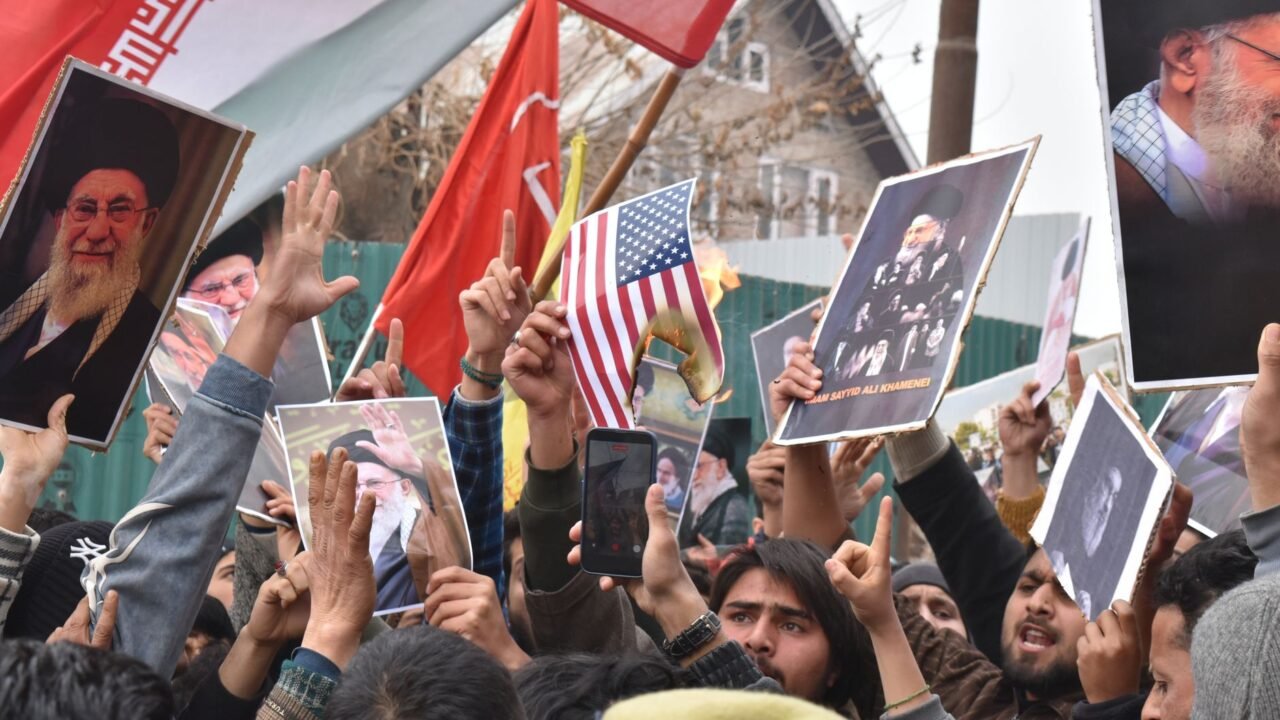
Kashmir’s chief preacher, Mirwaiz Umar Farooq, has appealed for calm amidst escalating tensions in West Asia, suggesting that India, drawing from Mahatma Gandhi’s philosophy of non-violence, could play a pivotal role in fostering dialogue and de-escalating the conflict. In a comprehensive two-page letter addressed to Iranian President Masoud Pezeshkian, the Mirwaiz also cautioned against allowing the ongoing crisis to become a catalyst for further division within the global Muslim community, imploring followers to unite against sectarianism and political rivalries.
The letter, which was formally handed over to Iranian Foreign Minister Abbas Araghchi during a meeting on the sidelines of the BRICS summit in New Delhi, highlighted the Mirwaiz’s recent interaction with President Pezeshkian during the latter’s visit to the Indian capital. The Mirwaiz conveyed his appreciation for the Iranian President’s emphasis on prioritizing humanity in the collective pursuit of peace during their discussions. As per information available with Tahir Rihat, President Pezeshkian was in India to attend the BRICS summit, during which he engaged with various intellectuals and scholars, including the Mirwaiz. Subsequently, a delegation led by the Mirwaiz, accompanied by Aga Syed Hassan and Molvi Imran Raza Ansari, met with Minister Araghchi.
Expressing solidarity with the people of Iran, the Mirwaiz conveyed deep concern over the escalating humanitarian crisis gripping the region, specifically mentioning the ongoing devastation in Palestine and the pervasive instability in Lebanon. He broadened his appeal beyond religious or regional affiliations, underscoring the universal imperative to care for human suffering, irrespective of sect or nationality. “Our concern must extend beyond Muslims alone. Human dignity has no sect or nationality. Every innocent life is precious,” the Mirwaiz stated, urging the international community to align itself with justice, humanity, and peace. The former separatist leader articulated that the profound challenges confronting the world cannot be resolved through escalating warfare, advocating instead for dialogue and negotiation as the primary means to address conflicts.
The Mirwaiz further elaborated on India’s potential contribution, stating, “India, with its legacy of Mahatma Gandhi’s philosophy of Ahimsa (non-violence), can also play a constructive role in encouraging restraint, engagement and diplomacy.” He reiterated his conviction that escalating conflicts only exacerbate global challenges, emphasizing that lasting solutions lie in dialogue and negotiation. “The grave challenges facing our world cannot be settled through ever-widening wars. Confrontation will only aggravate them; ultimately they must be addressed through dialogue and negotiation,” he asserted. He called for wisdom and statesmanship, noting that war invariably multiplies human suffering.
His prayer was for the current difficult juncture to serve as an awakening for the international community and the Muslim world, rather than a precursor to further conflict. “My prayer is that this difficult moment does not lead to further widening of conflict, but instead awakens the conscience of the international community and the Muslim world alike. May Allah preserve the unity of the Ummah, protect us from sectarian discord, and guide all of humanity towards justice, reconciliation and lasting peace,” he wrote. The Mirwaiz also highlighted the existing vulnerabilities faced by Muslims globally, including “Islamophobia and uncertainty,” warning against the dangers of allowing “sectarian differences and political rivalries” to further weaken the community. Quoting a verse from the Quran, he explained that unity within the Muslim faith does not necessitate agreement on all political or theological matters, but rather that differences should not supersede fundamental bonds of faith, brotherhood, and shared humanity. He urged Muslims worldwide to stand united against sectarianism and against attempts to politicize conflicts into divisions within the ‘Ummah’ (Muslim community).
As a gesture of goodwill and to symbolize the enduring cultural and spiritual connections, the Mirwaiz presented President Pezeshkian with a meticulously crafted replica of Srinagar’s historic Jama Masjid, fashioned from walnut wood. He explained that the gift carried a significance extending beyond its material value. “For centuries, the Jama Masjid has stood at the heart of the religious and spiritual life of the people of Kashmir,” he wrote, noting that its pulpit has consistently advocated for faith, brotherhood, and the broader responsibilities of the Muslim Ummah. The Mirwaiz underscored the centuries-old ties between Kashmir and Iran, acknowledging the profound influence of Persian scholarship, literature, art, and spirituality on Kashmiri civilization. He characterized these as deep-rooted bonds between peoples that have persevered through evolving political landscapes and across generations.
Recalling historical connections, the Mirwaiz also referenced the visit of Ayatollah Sayyid Ali Khamenei to Kashmir in the years following the Islamic Revolution. During that visit, Ayatollah Khamenei delivered a Friday sermon at the Jama Masjid, with the Mirwaiz’s late father, Mirwaiz Moulvi Mohammad Farooq, in attendance. The message delivered by Ayatollah Khamenei on that occasion, which focused on the Holy Quran, brotherhood, and Shia-Sunni unity, remains a vivid memory over four decades later, he added.

Tahir Rihat (also known as Tahir Bilal) is an independent journalist, activist, and digital media professional from the Chenab Valley of Jammu and Kashmir, India. He is best known for his work as the Online Editor at The Chenab Times.





Leave a Reply