
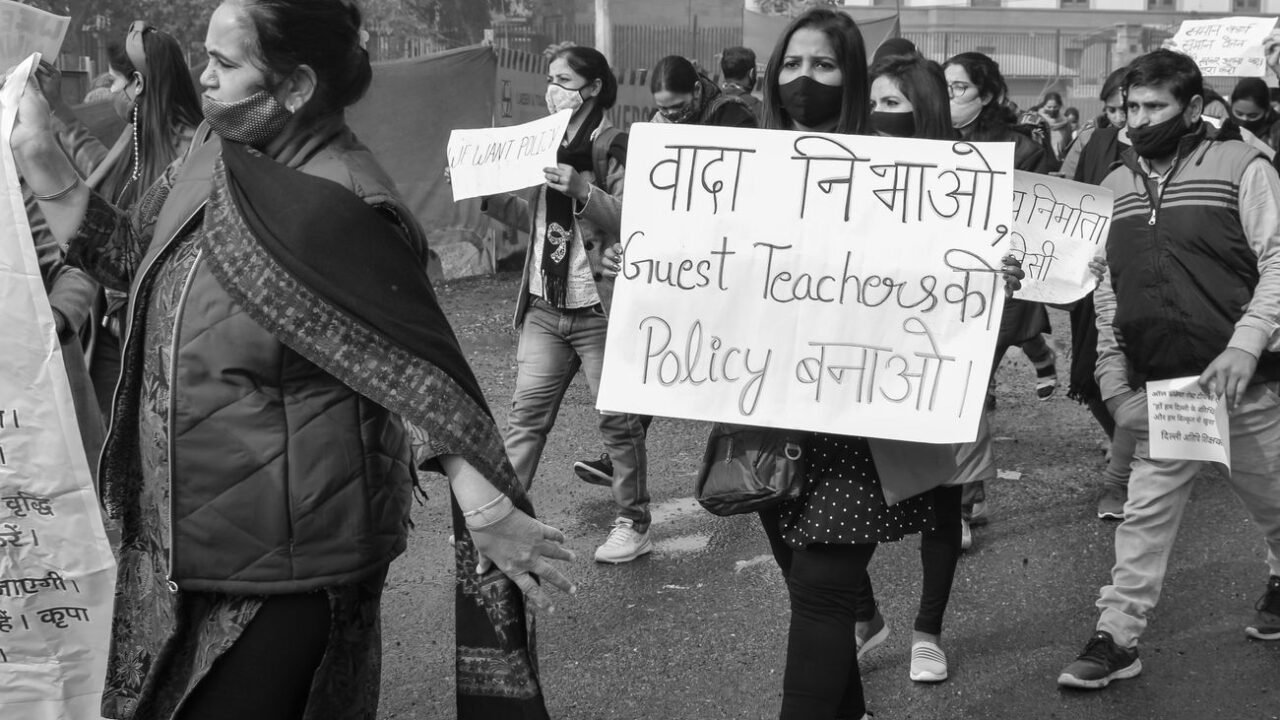
Hundreds of daily wagers, including a significant number of Accredited Social Health Activists (ASHAs), staged a protest march in Jammu on Monday, marking the first day of office reopenings following the traditional ‘Darbar Move’. The demonstrators are demanding the regularisation of their services and the strict implementation of the Minimum Wages Act. The protest, organised under the banner of the All Jammu and Kashmir Daily Wagers Sangharsh Samiti, saw participants attempting to breach barricades erected by the police, leading to a scuffle. Sunny Kant Chib, the president of the Sangharsh Samiti, was taken into custody during the confrontation.
The protesters had gathered with the intention of marching towards the Civil Secretariat to press their long-standing demands. As they advanced, they were met by a substantial police presence near the MLA Hostel, where barricades and barbed-wire fencing had been strategically placed to impede their progress towards the secretariat. Chib articulated the group’s frustration, stating that protests have been ongoing for the past two years, with unmet promises from Chief Minister Omar Abdullah regarding the regularisation of daily wagers. Information reaching Tahir Rihat suggests that the demonstrators are resolute in their pursuit of justice and equitable wages.
Chib further expressed strong sentiments regarding the government’s perceived inaction, asserting that the authority of the Chief Minister stems from the populace, particularly the working class. He argued that if the government cannot deliver justice to the impoverished, it forfeits its right to hold office. The Sangharsh Samiti president accused the administration of being more engrossed in political maneuvering than in addressing the genuine concerns of the common people. He alleged a focus on power acquisition and personal enrichment rather than on serving the needs of the less fortunate.
The All Jammu and Kashmir Daily Wagers Sangharsh Samiti has resolved to continue their agitation until their core demands, namely the regularisation of their employment status and the enforcement of the Minimum Wages Act, are met. The ‘Darbar Move’, a practice where the administrative capital of Jammu and Kashmir shifts between Srinagar and Jammu, typically marks periods of heightened political and administrative activity. However, for these daily wagers and ASHAs, the reopening of offices has instead become a catalyst for renewed protest, highlighting persistent issues of labour rights and economic security within the region. The ASHAs, who play a crucial role in public health delivery at the grassroots level, are particularly vocal about their precarious employment conditions and the need for better remuneration and job security.
The protest underscores a broader narrative of contractual and daily wage workers across various sectors in Jammu and Kashmir advocating for stable employment and fair compensation. Their demands are rooted in the principle of equal pay for equal work and the recognition of their contributions to public services. The government’s response to these persistent demands remains a critical point of contention, with protesters accusing officials of delaying tactics and a lack of genuine commitment to resolving their grievances. The detention of protest leaders, while a common tactic in managing public demonstrations, often serves to further galvanise the movement and draw wider attention to the issues at hand. The situation remains fluid as the Sangharsh Samiti vows to escalate their efforts until their demands are addressed.
The implementation of the Minimum Wages Act is a key demand, as many daily wagers reportedly earn significantly less than the legally stipulated minimum. This disparity not only affects their immediate livelihood but also impacts their long-term financial stability and access to essential services. The regularisation of services would provide these workers with a more secure employment status, including benefits such as provident fund, health insurance, and pension, which are often denied to those on daily wage or contractual terms. The ASHAs, in particular, have been instrumental in implementing various government health schemes, yet their own working conditions and financial compensation have often been a subject of concern and advocacy.
The ‘Darbar Move’ itself has been a subject of debate, with questions raised about its economic and administrative efficiency. For the protesting workers, the reopening of offices signifies a renewed opportunity to engage with the administration and highlight their plight. Their march towards the Civil Secretariat is a symbolic act, aiming to directly confront the seat of power and demand accountability. The police’s intervention, while aimed at maintaining law and order, has also been criticised by the protesters as an attempt to suppress their right to peaceful assembly and protest. The detention of Sunny Kant Chib is likely to intensify the resolve of the Sangharsh Samiti and potentially draw solidarity from other labour unions and civil society groups.
The political rhetoric surrounding the rights of the working class often contrasts sharply with the ground realities faced by daily wagers and ASHAs. Chib’s statements, as reported, reflect a deep-seated disillusionment with a system that he claims prioritises political expediency over the welfare of its citizens. The reference to the Chief Minister’s chair being occupied due to the votes of these very people serves as a stark reminder of the social contract between the electorate and the elected. The struggle for regularisation and fair wages is not merely an economic issue but also a matter of dignity and recognition for the labour provided by these essential workers. The coming days are expected to witness further developments as the protest movement seeks to maintain momentum and secure a positive resolution to their long-pending demands.

Tahir Rihat (also known as Tahir Bilal) is an independent journalist, activist, and digital media professional from the Chenab Valley of Jammu and Kashmir, India. He is best known for his work as the Online Editor at The Chenab Times.





Leave a Reply