
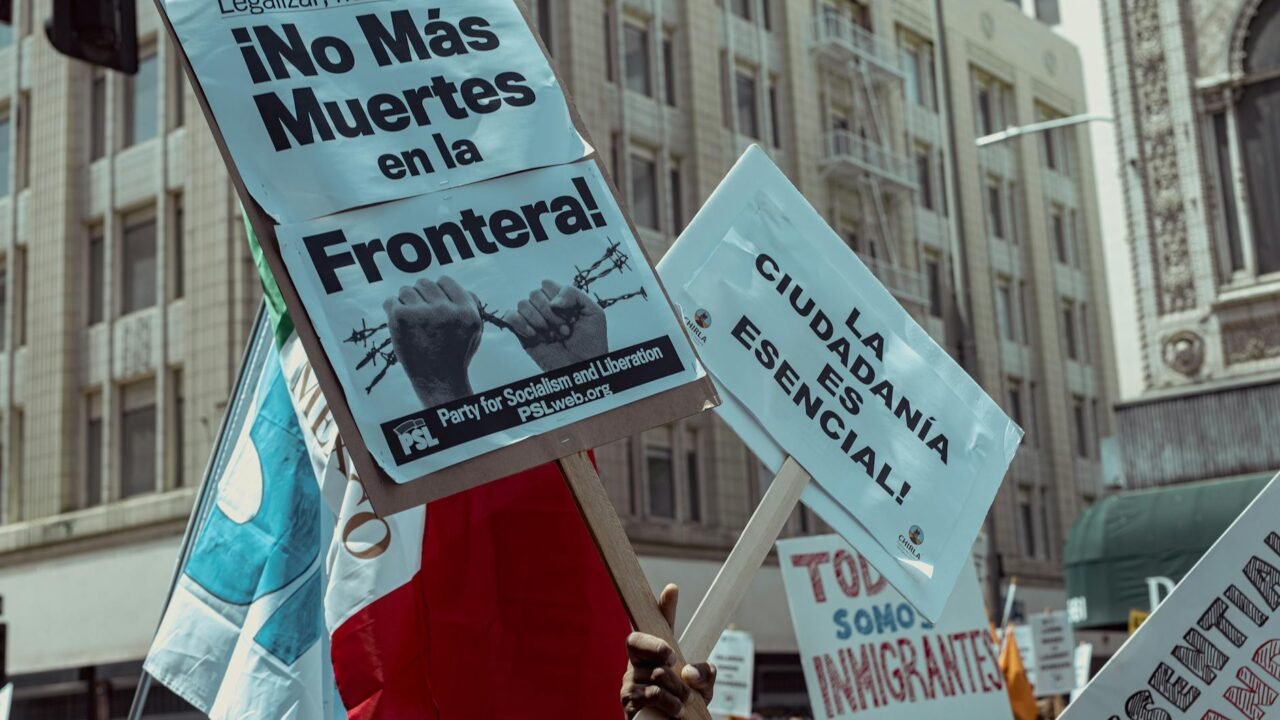
The Trump administration has issued new guidance to immigration officers, directing them to scrutinize Green Card applicants more closely for their views on Israel and their participation in pro-Palestinian protests. This directive, which describes such activities as “overwhelmingly negative” factors, signals a significant shift in how political expression is being weighed in the immigration process, particularly for those seeking permanent residency in the United States.
Information reaching TahirRihat.com suggests that the guidance, disseminated through internal memos, instructs officers to consider whether an applicant has engaged in protests against Israel or expressed views critical of the Israeli government. These expressions are now to be flagged as potential reasons to deny an applicant a Green Card, a status that allows foreign nationals to live and work permanently in the U.S. The policy appears to broaden the scope of what constitutes a security risk or a threat to public interest, extending it to political activism and speech related to international affairs.
The implications of this new scrutiny are far-reaching, potentially impacting thousands of individuals who have participated in demonstrations or voiced opinions on the Israeli-Palestinian conflict. Critics argue that this policy could stifle free speech and create a chilling effect on political discourse, particularly for immigrant communities who may feel compelled to self-censor their views to avoid jeopardizing their immigration status. The directive comes at a time of heightened tensions and debates surrounding the conflict, making the timing of such a policy particularly sensitive.
Under existing immigration law, applicants can be denied a Green Card if they are deemed a threat to national security or public safety, or if they are likely to become a public charge. However, this new guidance appears to interpret political speech and protest activity related to a foreign policy issue as falling under these broad categories. The administration’s stance suggests a redefinition of what constitutes a “negative” factor, moving beyond traditional security concerns to encompass political alignment with U.S. foreign policy objectives, specifically concerning Israel.
The guidance reportedly provides examples of actions that immigration officers should consider, including participation in boycotts, divestment, or sanctions campaigns targeting Israel, as well as public statements that are deemed to be anti-Israel. This move has raised concerns among civil liberties advocates and immigration lawyers, who fear that it could lead to arbitrary enforcement and discrimination. They point out that many individuals who participate in such activities do so as a form of political expression, protected under the First Amendment in the United States, even if their views are critical of a foreign government.
The policy change reflects a broader trend within the Trump administration to adopt a more stringent approach to immigration, emphasizing loyalty to American values and policies. In this context, views perceived as hostile to U.S. allies, such as Israel, are being framed as incompatible with the desire to become a permanent resident. The administration’s rationale, as implied by the guidance, is that individuals who actively oppose U.S. foreign policy positions, particularly on sensitive issues like the Israeli-Palestinian conflict, may not be aligned with the interests of the United States.
Immigration officers are reportedly being trained to identify and assess these expressions of opinion during interviews and through background checks. The subjective nature of assessing political views raises further questions about the fairness and consistency of the application of this new policy. It is unclear how broadly the term “criticizing Israel” will be interpreted, and whether it will encompass a wide range of opinions or be limited to more extreme forms of rhetoric. The lack of clear, objective criteria could lead to a discretionary application of the rules, potentially disadvantaging applicants based on the individual biases of immigration officers.
The potential impact on asylum seekers and refugees, who often come from regions with complex political situations and may have expressed strong opinions about their home countries or related conflicts, is also a significant concern. For individuals fleeing persecution, their political activism or expressed views might be a direct result of the very circumstances they are escaping. Applying such scrutiny to their Green Card applications could inadvertently penalize those seeking safety and refuge in the U.S.
This development is likely to face legal challenges, as civil rights organizations are expected to scrutinize the legality and constitutionality of using political speech as a basis for denying immigration benefits. The First Amendment protects the right to express political opinions, and any government action that infringes upon this right, particularly in the context of immigration, will be subject to legal review. The administration’s interpretation of “overwhelmingly negative” factors in the context of political expression could be a focal point of such legal battles.
The guidance also raises questions about the administration’s broader foreign policy objectives and how they are being integrated into domestic immigration policies. By linking immigration status to adherence to specific foreign policy stances, the administration appears to be using the immigration system as a tool to enforce its international agenda. This approach could have significant implications for the diversity of perspectives within the United States and the country’s role as a haven for those seeking political freedom and opportunity.
The long-term consequences of this policy could include a more politically homogenous immigrant population, as individuals with dissenting views may be deterred from applying for Green Cards. This could alter the demographic and ideological landscape of the United States, impacting its multicultural fabric and its tradition of welcoming diverse voices and opinions. The administration’s focus on specific political viewpoints in the immigration process marks a notable departure from previous approaches, which typically centered on economic self-sufficiency, family ties, and security concerns.
The policy’s implementation is expected to be closely watched by international observers and human rights groups, given the U.S.’s historical role as a beacon of freedom and opportunity. Any perceived erosion of these principles, particularly concerning political expression, could have broader implications for democratic values globally. The administration’s emphasis on aligning immigrant views with its foreign policy agenda, especially concerning Israel, underscores a significant shift in the criteria for becoming a permanent resident in the United States.

Tahir Rihat (also known as Tahir Bilal) is an independent journalist, activist, and digital media professional from the Chenab Valley of Jammu and Kashmir, India. He is best known for his work as the Online Editor at The Chenab Times.




Leave a Reply