
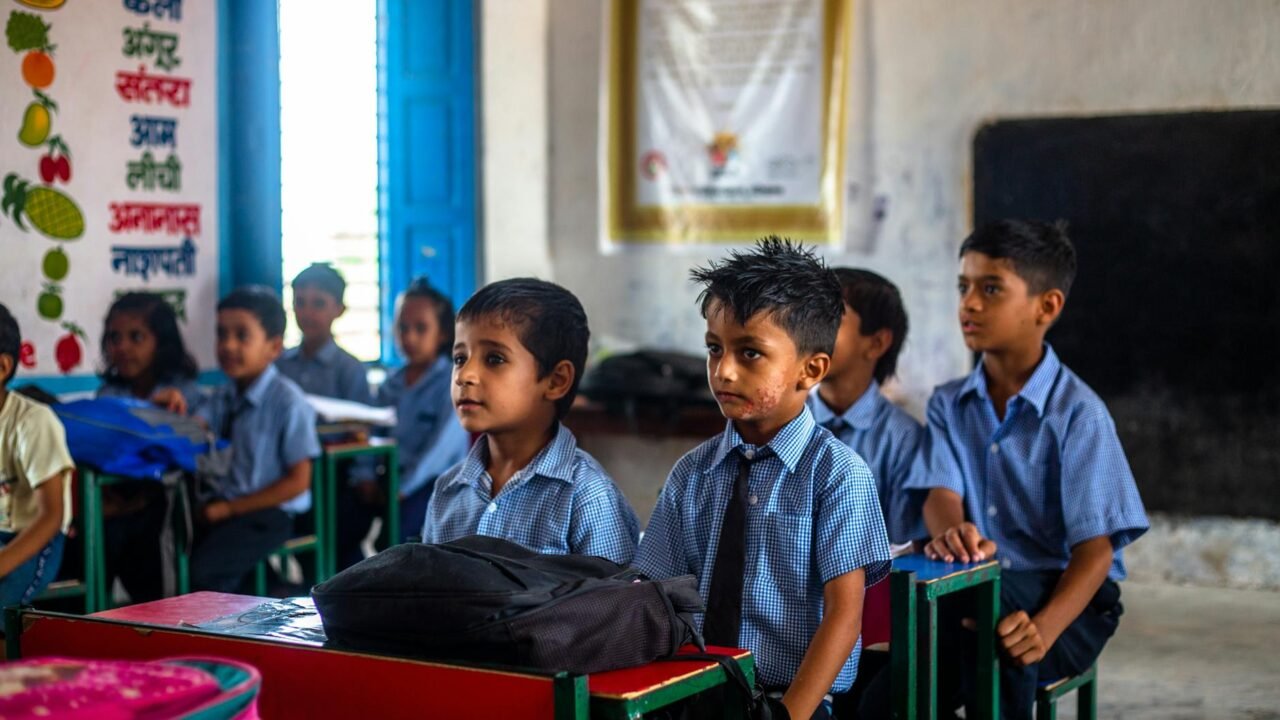
Thousands of schools across India are facing a severe crisis, with nearly 8,000 institutions reporting zero student enrollment, according to a recent report by Niti Aayog. The report, titled “School Education System in India: Temporal Analysis and Policy Roadmap for Quality Enhancement,” sheds light on the concerning state of education infrastructure and resource allocation in the country. The findings highlight significant disparities in school functionality, teacher availability, and infrastructure development, particularly in rural and tribal areas.
The Niti Aayog report, utilizing UDISE+ 2024-25 data, indicates that these schools, despite appearing operational in administrative records, are not serving any students. (The report stated that) this disconnect between official records and on-ground reality leads to the continued allocation of financial and human resources to institutions that are essentially non-functional. Among the states with the highest number of such schools are West Bengal, with 3,812 schools, and Telangana, which accounts for a staggering 12,245 institutions. Punjab and Jammu and Kashmir also recorded 13 and 146 such schools, respectively. As per information available with TahirRihat.com, the persistence of these schools with zero enrollment points to systemic issues in data management and resource allocation within the education sector.
The report also brings attention to the critical issue of teacher shortages, particularly in remote and underserved areas. (The report indicated that) over one lakh schools in India are currently operating with only a single teacher, representing more than 7% of the total number of schools. This scarcity of educators has a direct impact on the quality of education, leading to multi-grade classrooms and limited individual attention for students. States such as Jharkhand, Dadra and Nagar Haveli and Daman and Diu, Maharashtra, and West Bengal are grappling with pupil-teacher ratios significantly above the national average, exacerbating the challenges faced by both teachers and students.
In addition to teacher shortages, the report highlights persistent infrastructure gaps that hinder effective learning environments. While there has been progress in improving school sanitation facilities, a significant number of schools still lack functional toilets. (The report stated that) though the share of schools with functional toilets has increased from 85.17% in 2014 to 94% in 2024-25, over 98,592 schools do not have functional girls’ toilets, while 61,540 schools lack usable toilets altogether. This lack of basic sanitation facilities contributes to health-related issues and discourages student attendance, especially among girls.
The Niti Aayog report also examines the overall structure of the Indian school education system. According to the findings, India has over 14.71 lakh schools and nearly 24.69 crore students. However, 50% of these schools offer only primary education, covering grades 1 to 5. (The report noted that) only 5.4% of schools provide continuous schooling from Grade 1 to 12. This fragmented structure creates transition inefficiencies and increases the risk of students dropping out of the education system at various stages.
Furthermore, the study identifies acute staff shortages in several states, with Bihar facing a particularly dire situation. Bihar alone accounts for over 2.08 lakh elementary-level vacancies, along with 36,035 vacancies at the secondary level and 33,035 at the senior secondary level. Karnataka, Haryana, and Maharashtra also report significant shortfalls in teaching staff. The lack of adequate staffing levels directly impacts the quality of education and the ability of schools to effectively cater to the needs of their students. Moreover, most states lack formal career progression routes for teachers, such as senior teacher, master teacher, or mentor-teacher roles. (The report pointed out that) this limits opportunities for academic leadership and professional advancement, potentially discouraging experienced teachers from remaining in the profession.

Tahir Rihat (also known as Tahir Bilal) is an independent journalist, activist, and digital media professional from the Chenab Valley of Jammu and Kashmir, India. He is best known for his work as the Online Editor at The Chenab Times.





Leave a Reply