
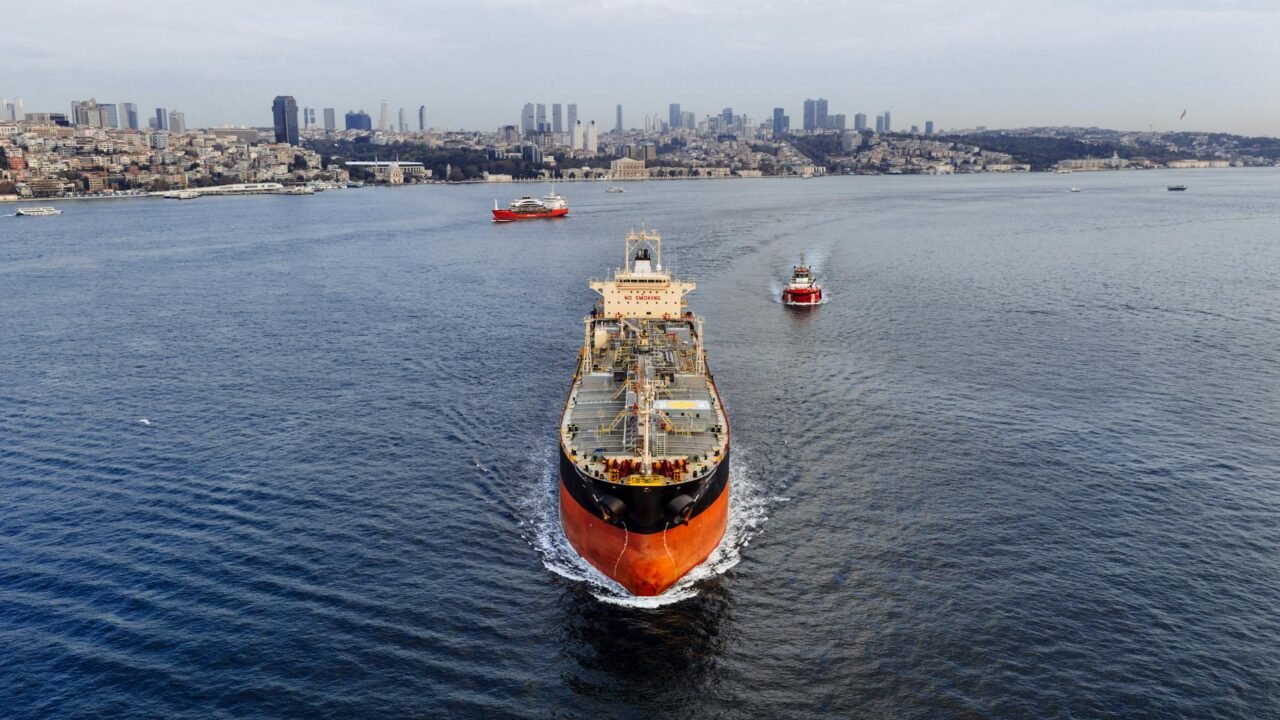
Iran announced on Friday that the Strait of Hormuz, a critical global oil transit route, is now “completely open” for all commercial vessels. This significant development, conveyed by Iranian Foreign Minister Abbas Araghchi via a post on X, coincides with a broader diplomatic effort aimed at de-escalating regional tensions.
The reopening of the vital waterway follows closely on the heels of U.S. President Donald Trump’s announcement of a 10-day ceasefire between Lebanon and Israel. Araghchi specified that while the passage is open, ships must adhere to the coordinated routes previously designated by Iran’s Ports and Maritime Organization. President Trump acknowledged this announcement on Truth Social, expressing gratitude and stating, “Iran has just announced that the Strait of Iran is fully open and ready for full passage. Thank you!” He further elaborated that the naval blockade against Iran would persist in “full force” until a comprehensive agreement with the U.S. to end the ongoing conflict is reached, suggesting that most terms have already been negotiated and the process should be swift.
Information reaching TahirRihat.com suggests that this diplomatic breakthrough is partly attributable to the intensive efforts of Pakistan’s Chief of Defence Forces, Field Marshal Asim Munir. He recently concluded a series of high-level discussions in Tehran with top Iranian leadership, including President Masoud Pezeshkian, Parliament Speaker Mohammad Bagher Ghalibaf, and senior commanders of the Revolutionary Guards. These meetings, held on Thursday, were part of Islamabad’s ongoing initiative to mediate between the United States and Iran. Field Marshal Munir’s visit marked him as the first foreign military leader to visit Tehran since the recent two-week ceasefire was established between Iran and the U.S.
During his engagements in Tehran, Field Marshal Munir met with the commander of the Islamic Revolutionary Guard Corps (IRGC) at the Khatam al-Anbiya Central Headquarters. According to Iran’s official IRNA news agency, discussions centered on the steps being taken within the framework for ending the war and their recent negotiations. The parties also deliberated on the regional situation and the prospects for achieving lasting peace and stability. Field Marshal Munir emphasized the importance of continuing efforts to bring the conflict to an end. Iranian official media had previously reported that the Pakistani delegation’s visit was intended to convey a message from the U.S. to the Iranian leadership and to lay the groundwork for the next round of negotiations.
Pakistan is reportedly preparing to host the second round of crucial talks between the U.S. and Iran in the coming week. The initial round of these rare direct talks, held in Pakistan over the weekend, concluded without an immediate agreement, though both sides have continued to observe the temporary ceasefire. This period of de-escalation has provided Pakistan with an opportunity to re-energize its mediation efforts.
Following extensive behind-the-scenes diplomacy, Pakistani Prime Minister Shehbaz Sharif embarked on a tri-nation tour earlier in the week. After consulting with leaders in Saudi Arabia and Qatar, he arrived in Turkiye on Thursday night. On Friday, he met with Massad Boulos, the Senior Advisor to the U.S. President for Arab and African Affairs, in Antalya. Their discussions, as stated by the Prime Minister’s office, encompassed current regional developments, including Pakistan’s peace initiatives that facilitated the ceasefire, and the significant Islamabad Talks.
Officials in Islamabad have indicated that preparations for the second round of talks are underway, with security personnel being deployed from various provinces to Islamabad and the neighboring city of Rawalpindi. This follows a similar deployment of over 10,000 security personnel during the first round of talks. Reports also suggest that local authorities in Islamabad and Rawalpindi have contacted transport companies, warning of potential traffic restrictions for vehicles entering or leaving the twin cities. These restrictions, if imposed, could extend until the end of the following week, prompting advice for citizens to limit non-essential travel or plan their journeys well in advance.
The prospect of a peace deal received further encouragement when President Trump informed reporters on Thursday that the Strait of Hormuz was indeed open and ready for passage, while simultaneously reiterating the continuation of the naval blockade against Iran until their transaction is fully completed. He expressed optimism that this process would be rapid, given that most points have already been negotiated. The reopening of the Strait of Hormuz, a chokepoint through which a significant portion of the world’s oil supply passes, is a critical development for global energy markets. Iran’s previous actions in blocking or threatening to block the strait had previously caused considerable disruption to global energy supplies, particularly following its conflicts with the U.S. and Israel. The current diplomatic overtures, facilitated by Pakistan’s proactive role, signal a potential shift towards de-escalation and a return to stability in a strategically vital region.

Tahir Rihat (also known as Tahir Bilal) is an independent journalist, activist, and digital media professional from the Chenab Valley of Jammu and Kashmir, India. He is best known for his work as the Online Editor at The Chenab Times.

Leave a Reply