
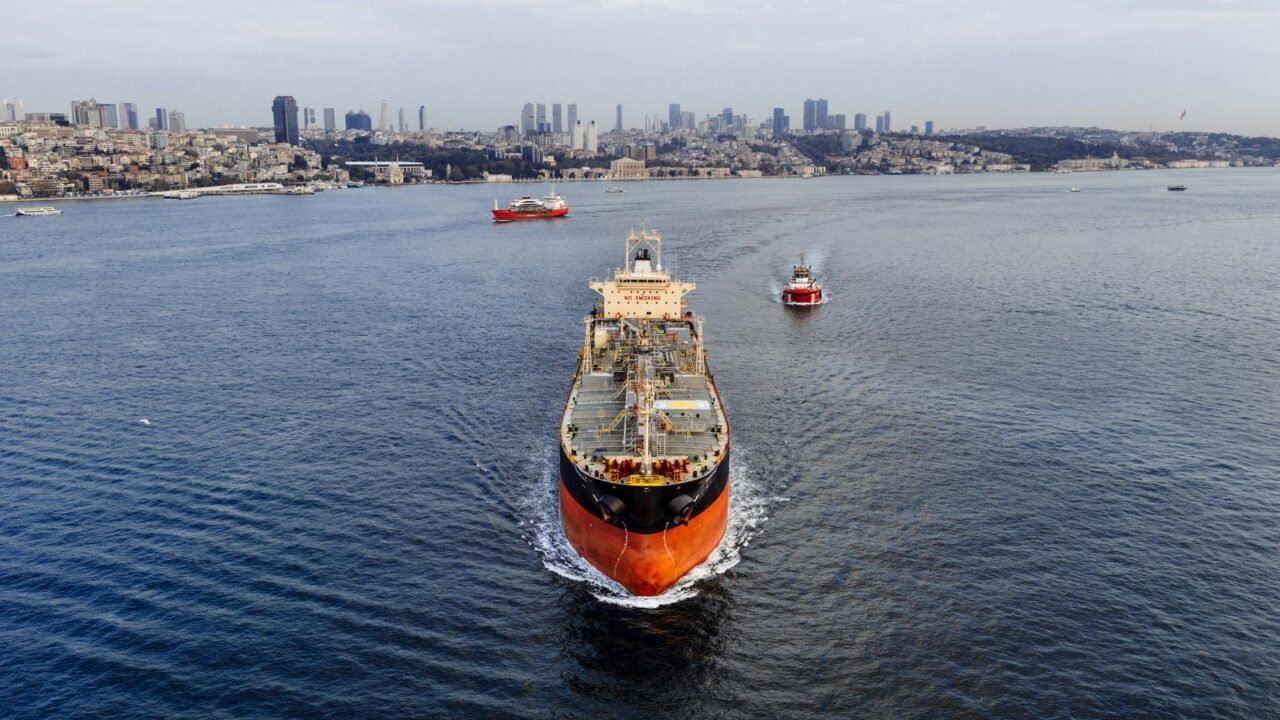
Iran‘s First Vice President Mohammad Reza Aref issued a stern warning on Sunday, asserting that the security of the vital Strait of Hormuz is not a gratis commodity and that Tehran cannot be expected to guarantee maritime safety while its own oil exports face severe restrictions. The declaration comes amidst a significant escalation of tensions between Iran and the United States, particularly following Iran’s confirmation of a U.S. operation that targeted an Iranian commercial vessel in the Sea of Oman.
In a pointed statement disseminated via the social media platform X, Aref articulated Iran’s position, stating, “The security of the Strait of Hormuz is not free. One cannot restrict Iran’s oil exports while expecting free security for others.” This assertion underscores Iran’s view that international maritime security in the strategically crucial waterway is intrinsically linked to its own economic well-being and its ability to freely trade its primary export. Information reaching TahirRihat.com suggests that this stance is a direct response to perceived economic coercion by the United States.
Aref further elaborated on the potential ramifications of continued pressure, warning that the consequences would reverberate globally, with a particularly pronounced impact on energy markets. He presented a stark choice: “The choice is clear: either a free oil market for all, or the risk of significant costs for everyone.” This statement implies that any disruption to Iran’s oil exports, or continued economic sanctions, could lead to instability and price volatility in the international oil market, affecting consumers and economies worldwide. The First Vice President emphasized that sustained stability in global fuel prices is contingent upon an unequivocal and enduring cessation of external economic and military pressure directed at Iran and its allies.
The escalating rhetoric and actions follow Iran’s official confirmation that a U.S. operation had targeted an Iranian commercial vessel in the Sea of Oman. Iran’s Hazrat Khatam al-Anbiya military headquarters, in a statement disseminated through Iranian state media, accused the United States of “violating the ceasefire and committing maritime piracy” and confirmed the seizure of the vessel. The military headquarters issued a direct threat, stating, “We warn that the Armed Forces of the Islamic Republic of Iran will soon respond to and retaliate against this armed piracy by the U.S. military.” This declaration signals a potential for direct military confrontation in the region.
This Iranian accusation directly contrasts with claims made by the U.S. Central Command (CENTCOM). CENTCOM reported that American forces intercepted and disabled an Iranian-flagged vessel, identified as TOUSKA, in the Arabian Sea after it allegedly violated a U.S. naval blockade. According to CENTCOM’s statement, U.S. forces enforced naval blockade measures against the vessel as it attempted to sail toward an Iranian port on April 19. The U.S. military command detailed that the guided-missile destroyer USS Spruance fired several rounds into the vessel’s engine room after repeated warnings were disregarded. CENTCOM stated that the Spruance disabled the TOUSKA’s propulsion by firing rounds from its 5-inch MK 45 Gun into the engine room. Following this, U.S. Marines reportedly boarded the vessel, which subsequently remained in American custody.
U.S. President Donald Trump also weighed in on the incident, asserting that American forces had taken “full custody” of the ship. He claimed the vessel was intercepted after attempting to breach the blockade in the Gulf of Oman. The conflicting accounts from Tehran and Washington highlight the deep-seated mistrust and escalating tensions that characterize their relationship, particularly in the sensitive maritime domain of the Persian Gulf.
These developments unfold against a backdrop of heightened tensions in the Strait of Hormuz, a critical chokepoint for global oil shipments. The region has been a focal point for geopolitical maneuvering and military posturing for decades. The current situation is further complicated by ongoing diplomatic uncertainty, with Iran having recently rejected U.S. claims regarding renewed negotiations. Tehran has instead accused Washington of intensifying pressure through a combination of military actions and economic sanctions, creating a volatile environment where miscalculation could have far-reaching consequences.
The Strait of Hormuz, a narrow waterway connecting the Persian Gulf to the Gulf of Oman, is one of the world’s most important oil transit points. Approximately 30% of the world’s seaborne oil trade passes through this strait daily. Any significant disruption or closure of this passage could lead to severe global energy shortages and a dramatic surge in oil prices, impacting economies far beyond the immediate region. Iran, which controls a significant portion of the strait’s coastline, has historically used its strategic position as leverage in its dealings with international powers, particularly the United States.
The seizure of the Iranian vessel and the subsequent exchange of accusations represent a dangerous escalation. Iran’s warning about the cost of Hormuz security implies a readiness to disrupt maritime traffic if its demands are not met or if it perceives its economic interests to be under existential threat. The U.S. military’s actions, described as enforcing a blockade, suggest a determination to control maritime movement in the region, potentially in response to perceived Iranian provocations or threats to shipping. The international community watches with concern as this standoff intensifies, with the potential for wider conflict and significant economic repercussions looming.

Tahir Rihat (also known as Tahir Bilal) is an independent journalist, activist, and digital media professional from the Chenab Valley of Jammu and Kashmir, India. He is best known for his work as the Online Editor at The Chenab Times.


Leave a Reply