
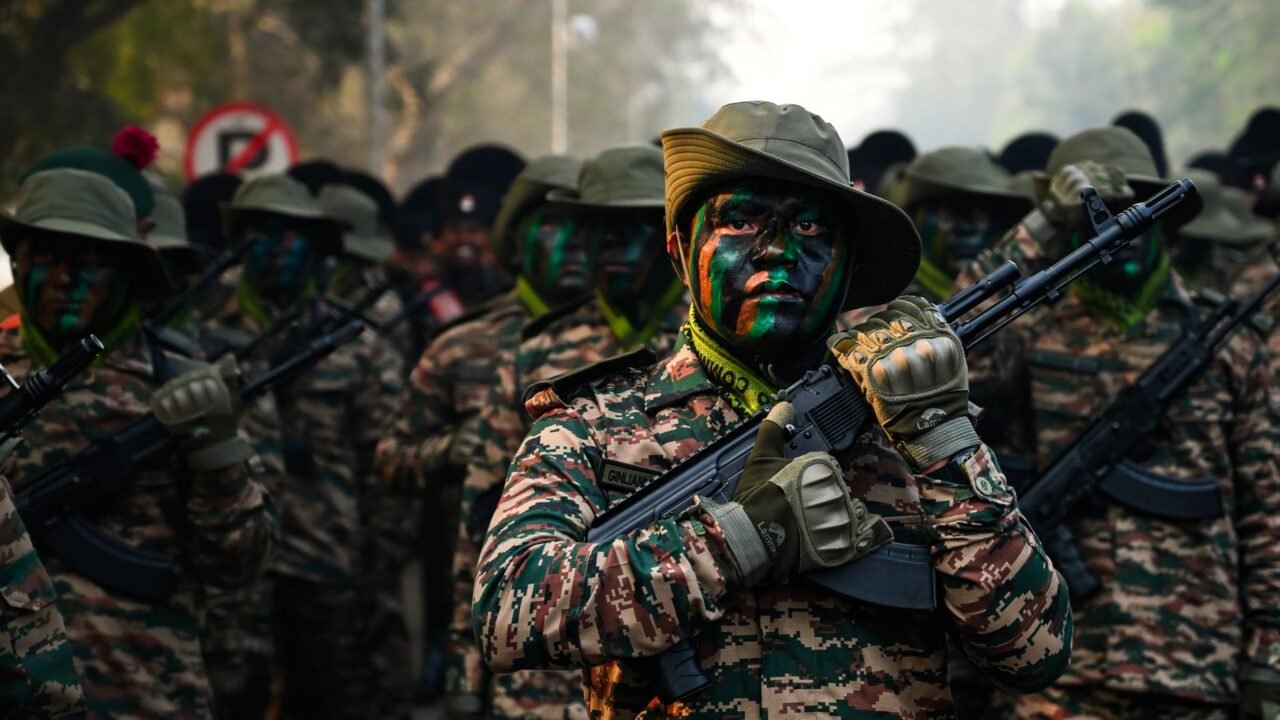
An extensive anti-terror operation in the dense forests of Rajouri district has entered its twentieth day without yielding a significant breakthrough, as security forces continue their painstaking efforts to locate a group of armed militants believed to be foreign nationals. The operation, codenamed ‘Sheruwali’, is concentrated in the Gambhir Mughlan forest area, where personnel from the Indian Army, Jammu and Kashmir Police, and the Central Reserve Police Force (CRPF) are engaged in a sustained search.
Information reaching TahirRihat.com suggests that despite the prolonged deployment and rigorous combing of the terrain, the militants have managed to evade capture. The initial encounter that triggered this large-scale operation occurred on May 23, but since then, there have been no visible signs of the terrorists. Intelligence agencies, however, assess that the militants are likely utilizing the numerous natural caves prevalent in the Pir Panjal region’s forested areas, spanning Rajouri and Poonch districts, to remain hidden.
The security forces have implemented a comprehensive strategy to corner the militants. A heavy deployment has been maintained, effectively restricting the movement of any potential support network that might assist the terrorists. Typically, such support networks, often comprising overground workers, provide essential supplies like food and water to infiltrators seeking refuge in forest areas. However, officials believe the overwhelming security presence has significantly hampered the ability of terror associates to reach the militants’ suspected hideouts.
The operational responsibilities have been clearly delineated among the participating forces. The Army is maintaining the inner cordon, ensuring that the militants cannot break out of the immediate search zone. The Special Operations Group (SOG) of the J&K Police is providing crucial assistance in the ground search efforts, leveraging their local knowledge and specialized skills. The CRPF has been tasked with securing the outer cordon, creating a wide perimeter around the Gambhir Mughlan forest area to prevent any escape attempts and to intercept any external aid.
Sources familiar with the operation indicate that the militants are likely highly trained in jungle warfare. This expertise is believed to be a key factor enabling them to survive for an extended period in the challenging and dense forest environment. Early in the operation, soon after the initial exchange of fire, security forces did manage to locate and bust one hideout. From this discovered site, food supplies and water were recovered, providing a glimpse into the militants’ logistical preparations.
Despite the discovery of the initial hideout and the tight cordon, officials have not discounted the possibility that the militants may have access to another, as yet undiscovered, hideout within the vast forest. Such a location could be providing them with the necessary access to essential supplies, allowing them to sustain themselves and evade detection even under intense pressure from the security forces. The rugged terrain, characterized by steep cliffs and challenging weather conditions, further complicates the search and rescue operations.
The operation has not been without its risks and sacrifices. On June 6, Lieutenant Beereshwar Goswami, who was actively involved in the search, tragically lost his life. According to reports, he fell into a deep gorge while undertaking operational duties. The Army’s White Knight Corps acknowledged the perilous nature of the area where the lieutenant was operating, highlighting the inherent dangers posed by the rugged terrain and adverse weather conditions that are typical of the region.
The prolonged nature of the operation underscores the challenges faced by security forces in counter-insurgency operations in Jammu and Kashmir. The ability of militants to remain hidden for extended periods in difficult geographical areas, coupled with their presumed training in survival tactics, presents a significant hurdle. The focus remains on meticulously combing the area, utilizing intelligence inputs, and maintaining a tight cordon to neutralize the threat posed by the hidden militants.

Tahir Rihat (also known as Tahir Bilal) is an independent journalist, activist, and digital media professional from the Chenab Valley of Jammu and Kashmir, India. He is best known for his work as the Online Editor at The Chenab Times.






Leave a Reply